Serverless Data Processing with Dataflow: Operations
Earned Jan 3, 2025 EST
[DEPRECATED] Advanced Performance Measurement
Earned Nov 12, 2024 EST
Conversational AI Voice and Chat Integrations
Earned Nov 12, 2024 EST
[Deprecated] Advanced Webhook Concepts
Earned Nov 12, 2024 EST
Advanced Conversation Design
Earned Nov 12, 2024 EST
Conversational AI and its Engagement Framework
Earned Nov 7, 2024 EST
DEPRECATED Planning for a Google Workspace Deployment
Earned Nov 4, 2024 EST
Google Workspace Data Governance
Earned Nov 4, 2024 EST
Google Workspace Security
Earned Oct 24, 2024 EDT
Google Workspace Core Services
Earned Oct 24, 2024 EDT
Google Workspace User and Resource Management
Earned Oct 24, 2024 EDT
Generative AI Fundamentals
Earned Jul 5, 2024 EDT
透過 Vertex AI 建構及部署機器學習解決方案
Earned Jun 28, 2024 EDT
Serverless Data Processing with Dataflow: Foundations
Earned Jun 27, 2024 EDT
Building Resilient Streaming Systems on Google Cloud Platform
Earned Jun 21, 2024 EDT
Build Data Lakes and Data Warehouses on Google Cloud
Earned Jun 18, 2024 EDT
Preparing for your Professional Data Engineer Journey
Earned Jun 14, 2024 EDT
Machine Learning Operations (MLOps): Getting Started
Earned Jun 13, 2024 EDT
在 Google Cloud 為機器學習 API 準備資料
Earned Jun 13, 2024 EDT
Machine Learning Operations (MLOps) with Vertex AI: Manage Features
Earned Jun 10, 2024 EDT
Recommendation Systems on Google Cloud
Earned Jun 7, 2024 EDT
Natural Language Processing on Google Cloud
Earned Jun 5, 2024 EDT
Production Machine Learning Systems
Earned May 30, 2024 EDT
Machine Learning in the Enterprise
Earned May 29, 2024 EDT
Feature Engineering
Earned May 28, 2024 EDT
Build, Train and Deploy ML Models with Keras on Google Cloud
Earned May 27, 2024 EDT
Integrate Vertex AI Search and Conversation into Voice and Chat Apps
Earned May 23, 2024 EDT
Develop Advanced Enterprise Search and Conversation Applications
Earned May 21, 2024 EDT
Custom Search with Embeddings in Vertex AI
Earned May 21, 2024 EDT
圖像生成簡介
Earned May 16, 2024 EDT
Generative AI Fundamentals - 繁體中文
Earned May 16, 2024 EDT
Generative AI Explorer : Vertex AI
Earned May 15, 2024 EDT
Vector Search 和嵌入
Earned May 15, 2024 EDT
Implementing Generative AI with Vertex AI
Earned May 15, 2024 EDT
Text Prompt Engineering Techniques
Earned May 14, 2024 EDT
Vertex AI Studio 簡介
Earned May 14, 2024 EDT
Generative AI for Business Leaders
Earned May 13, 2024 EDT
負責任的 AI 技術:透過 Google Cloud 採用 AI 開發原則
Earned May 10, 2024 EDT
負責任的 AI 技術簡介
Earned May 10, 2024 EDT
大型語言模型簡介
Earned May 10, 2024 EDT
生成式 AI 簡介
Earned May 10, 2024 EDT
建立圖像說明生成模型
Earned May 10, 2024 EDT
Transformer 和 BERT 模型
Earned May 9, 2024 EDT
編碼器-解碼器架構
Earned May 9, 2024 EDT
注意力機制
Earned May 9, 2024 EDT
Launching into Machine Learning
Earned May 2, 2024 EDT
Google Cloud 的 AI 和機器學習服務簡介
Earned Apr 29, 2024 EDT
Complete the Extend Gemini with controlled generation and Tool use skill badge to demonstrate your proficiency in connecting models to external tools and APIs. This allows models to augment their knowledge, extend their capabilities and interact with external systems to take actions such as sending an email.
A skill badge is an exclusive digital badge issued by Google Cloud in recognition of your proficiency with Google Cloud products and services and tests your ability to apply your knowledge in an interactive hands-on environment. Complete the assessment challenge lab, to receive a skill badge that you can share with your network.
When you complete this course, you can earn the badge displayed here and claim it on Credly! Boost your cloud career by showing the world the skills you have developed!"
了解详情
An LLM-based application can process language in a way that resembles thought. But if you want to extend its capabilities to take actions by running other functions you have coded, you will need to use function calling. This can also be referred to as tool use. Additionally, you can give a model the ability to search Google or search a data store of documents to ground its responses. In other words, to base its answers on that information. In this course, you’ll explore these concepts.
了解详情
Learn a variety of strategies and techniques to engineer effective prompts for generative models
了解详情
Learn how to leverage Gemini multimodal capabilities to process and generate text, images, and audio and to integrate Gemini through APIs to perform tasks such as content creation and summarization.
了解详情
The course aims to train Google technical sales partners on the business value discovery process using proprietary content.
Course activities use an external tool (Yoodli). Refer to Yoodli's Terms of Service and Privacy Notice.
Note: The Yoodli Labs in this course will be deprecated on March 31st. We encourage you to finish your remaining Yoodli Labs before the March 31 deadline.
了解详情
「生成式 AI 代理:實現組織轉型」是 Gen AI Leader 學習路徑的第五堂也是最後一堂課程。本課程將探討組織如何運用自訂生成式 AI 代理,解決特定的業務難題。您將動手練習建構基本的生成式 AI 代理,同時探索這類代理的各種元件,例如模型、推論迴圈和工具。
了解详情
「生成式 AI 應用程式:徹底改變工作方式」是 Generative AI Leader 學習路徑的第四門課程。本課程將介紹 Google 的生成式 AI 應用程式,例如 Gemini for Workspace 和NotebookLM,也會引導您瞭解各種概念,像是建立基準、檢索增強生成、建構有效的提示詞,以及打造自動化工作流程等。
了解详情
「生成式 AI:掌握幕後技術與環境」是 Generative AI Leader 學習路徑的第三門課程。生成式 AI 正在改變我們的工作方式,以及我們如何與周遭的世界互動。身為領導者,您要如何駕馭 AI 強大的功能,創造實際業務成果?在本課程中,您將認識建構生成式 AI 解決方案時的各個層面、Google Cloud 產品,以及選擇解決方案時應考量的因素。
了解详情
「生成式 AI: 瞭解基礎概念」是 Generative AI Leader 學習路徑的第二門課程。在本課程中,您將瞭解 AI、機器學習和生成式 AI 的差異,以及各種資料類型如何協助生成式 AI 解決業務難題,進而掌握生成式 AI 的基礎概念。您還能深入瞭解 Google Cloud 應對基礎
模型限制的策略,以及開發、部署安全且負責任的 AI 技術時面臨的主要挑戰。
了解详情
「生成式 AI:不只是聊天機器人」是 Generative AI Leader 學習路徑的第一門課程,沒有任何修課條件。本課程將帶您超越基本知識,進一步瞭解聊天機器人,探索如何在組織中充分發揮生成式 AI 的潛力。您將瞭解基礎模型和提示工程等概念,掌握善用生成式AI 的關鍵。本課程也會帶您瞭解擬定生成式 AI 策略時的多種重要考量,協助您為組織擬定出成功的策略。
了解详情
本課程會說明 Gemini in BigQuery,這是一套由 AI 輔助的功能,可協助「從資料到 AI」的工作流程。這些功能包含資料探索和準備、程式碼生成和疑難排解,以及工作流程探索和視覺化。本課程將透過概念解說、應用實例和實作實驗室,協助資料從業人員提升工作效率,並加速開發 pipeline。
了解详情
在本課程中,您會學到 Google Cloud 上的資料工程、資料工程師的角色與職責,以及這些內容如何對應至 Google Cloud 提供的服務。您也將瞭解處理資料工程難題的許多方法。
Complete the Extend Gemini Enterprise Assistant Capabilities skill badge to demonstrate your ability to extend Gemini Enterprise assistant's capabilities with actions, grounding with Google Search, and a conversational agent.
A skill badge is an exclusive digital badge issued by Google Cloud in recognition of your proficiency with Google Cloud products and services and tests your ability to apply your knowledge in an interactive hands-on environment. Complete the assessment challenge lab, to receive a skill badge that you can share with your network.
When you complete this course, you can earn the badge displayed here and claim it on Credly! Boost your cloud career by showing the world the skills you have developed!
了解详情
Gemini Enterprise 結合 Google 的搜尋和 AI 輔助功能,企業員工只要在單一搜尋列輸入關鍵字,就能查找文件儲存空間、電子郵件、對話、支援單處理系統和其他資料來源中的特定資訊。Gemini Enterprise 助理還能協助人員腦力激盪、研究資訊、列出文件大綱及執行其他動作,例如邀請同事加入日曆活動,加快完成知識型工作及各種協作作業。(請注意,Gemini Enterprise 先前稱為 Google Agentspace,本課程可能會提及產品舊稱。)
了解详情
In this skill badge, you will demonstrate your ability to deploy Google Agentspace and set up data stores and actions. To learn these skills, we encourage you to take the course Accelerate Knowledge Exchange with Agentspace.
了解详情
In the last installment of the Dataflow course series, we will introduce the components of the Dataflow operational model. We will examine tools and techniques for troubleshooting and optimizing pipeline performance. We will then review testing, deployment, and reliability best practices for Dataflow pipelines. We will conclude with a review of Templates, which makes it easy to scale Dataflow pipelines to organizations with hundreds of users. These lessons will help ensure that your data platform is stable and resilient to unanticipated circumstances.
了解详情
In this course, you will learn about advanced methods and tools to monitor the performance of your virtual agents in Dialogflow CX
了解详情
Learn about building conversational AI voice and chat integrations, including how telephony systems can connect with Google to enable phone-based interactions within the Conversational AI ecosystem. Explore key topics such as the differences between chat and voice conversations, the writing process for creating conversation scripts, and the beginning of the interrogative series and closing sequence.
了解详情
This course explores advanced technical considerations to optimize Webhook connectivity for comprehensive, end-to-end, Virtual Agent self-service experiences.
了解详情
In this course, you will learn the advanced conversational design principles for both the Voice and Caht channels to craft engaging and effective end-to-end experiences that emulate human-like interactions.
了解详情
Transform your understanding of customer service with this course on the Customer Engagement Suite (CES) and its powerful generative AI capabilities. You'll start by tracing the journey of contact centers, understanding how they've evolved and where gen AI is propelling them next. Then, you'll gain a deep understanding of the core building blocks within the CES solution, seeing how each component contributes to delivering exceptional customer experiences. The course concludes by exploring the robust business case for CES, along with practical use cases and the various user personas that benefit from this innovative solution.
了解详情
Planning for a Google Workspace Deployment is the final course in the Google Workspace Administration series.
In this course, you will be introduced to Google's deployment methodology and best practices. You will follow Katelyn and Marcus as they plan for a Google Workspace deployment at Cymbal. They'll focus on the core technical project areas of provisioning, mail flow, data migration, and coexistence, and will consider the best deployment strategy for each area.
You will also be introduced to the importance of Change Management in a Google Workspace deployment, ensuring that users make a smooth transition to Google Workspace and gain the benefits of work transformation through communications, support, and training.
This course covers theoretical topics, and does not have any hands on exercises. If you haven’t already done so, please cancel your Google Workspace trial now to avoid any unwanted charges.
了解详情
This course equips learners with skills to govern data within their Google Workspace environment. Learners will explore data loss prevention rules in Gmail and Drive to prevent data leakage. They will then learn how to use Google Vault for data retention, preservation, and retrieval purposes. Next, they will learn how to configure data regions and export settings to align with regulations. Finally, learners will discover how to classify data using labels for enhanced organization and security.
了解详情
This course empowers learners to secure their Google Workspace environment. Learners will implement strong password policies and two-step verification to govern user access. They will then utilize the security investigation tool to proactively identify and respond to security risks. Next, they will manage third-party app access and mobile devices to ensure security. Finally, learners will enforce email security and compliance measures to protect organizational data.
了解详情
This course was designed to give learners a comprehensive understanding of Google Workspace core services. Learners will explore enabling, disabling, and configuring settings for these services, including Gmail, Calendar, Drive, Meet, Chat, and Docs. Next, they'll learn how to deploy and manage Gemini to empower their users. Finally, learners will examine use cases for AppSheet and Apps Script to automate tasks and extend the functionality of Google Workspace applications.
了解详情
This course was designed to provide an understanding of user and resource management in Google Workspace. Learners will explore the configuration of organizational units to align with their organization's needs. Additionally, learners will discover how to manage various types of Google Groups. They will also develop expertise in managing domain settings within Google Workspace. Finally, learners will master the optimization and structuring of resources within their Google Workspace environment.
了解详情
Earn a skill badge by passing the final quiz, you'll demonstrate your understanding of foundational concepts in generative AI.
A skill badge is a digital badge issued by Google Cloud in recognition of your knowledge of Google Cloud products and services. Share your skill badge by making your profile public and adding it to your social media profile.
了解详情
完成 透過 Vertex AI 建構及部署機器學習解決方案 課程,即可瞭解如何使用 Google Cloud 的 Vertex AI 平台、AutoML 和自訂訓練服務, 訓練、評估、調整、解釋及部署機器學習模型。 這個技能徽章課程適合專業數據資料學家和機器學習 工程師,完成即可取得中階技能徽章。技能 徽章是 Google Cloud 核發的獨家數位徽章, 用於肯定您在 Google Cloud 產品和服務方面的精通程度, 代表您已通過測驗,能在互動式實作環境應用相關知識。完成這個技能徽章課程 和結業評量挑戰實驗室,就能獲得數位徽章, 並與親友分享。
了解详情
This course is part 1 of a 3-course series on Serverless Data Processing with Dataflow. In this first course, we start with a refresher of what Apache Beam is and its relationship with Dataflow. Next, we talk about the Apache Beam vision and the benefits of the Beam Portability framework. The Beam Portability framework achieves the vision that a developer can use their favorite programming language with their preferred execution backend. We then show you how Dataflow allows you to separate compute and storage while saving money, and how identity, access, and management tools interact with your Dataflow pipelines. Lastly, we look at how to implement the right security model for your use case on Dataflow.
了解详情
This 1-week, accelerated on-demand course builds upon Google Cloud Platform Big Data and Machine Learning Fundamentals. Through a combination of video lectures, demonstrations, and hands-on labs, you'll learn to build streaming data pipelines using Google cloud Pub/Sub and Dataflow to enable real-time decision making. You will also learn how to build dashboards to render tailored output for various stakeholder audiences.
了解详情
While the traditional approaches of using data lakes and data warehouses can be effective, they have shortcomings, particularly in large enterprise environments. This course introduces the concept of a data lakehouse and the Google Cloud products used to create one. A lakehouse architecture uses open-standard data sources and combines the best features of data lakes and data warehouses, which addresses many of their shortcomings.
了解详情
This course helps learners create a study plan for the PDE (Professional Data Engineer) certification exam. Learners explore the breadth and scope of the domains covered in the exam. Learners assess their exam readiness and create their individual study plan.
了解详情
This course introduces participants to MLOps tools and best practices for deploying, evaluating, monitoring and operating production ML systems on Google Cloud. MLOps is a discipline focused on the deployment, testing, monitoring, and automation of ML systems in production. Machine Learning Engineering professionals use tools for continuous improvement and evaluation of deployed models. They work with (or can be) Data Scientists, who develop models, to enable velocity and rigor in deploying the best performing models.
了解详情
完成 在 Google Cloud 為機器學習 API 準備資料 技能徽章入門課程,即可證明您具備下列技能: 使用 Dataprep by Trifacta 清理資料、在 Dataflow 執行資料管道、在 Dataproc 建立叢集和執行 Apache Spark 工作,以及呼叫機器學習 API,包含 Cloud Natural Language API、Google Cloud Speech-to-Text API 和 Video Intelligence API。
了解详情
This course introduces participants to MLOps tools and best practices for deploying, evaluating, monitoring and operating production ML systems on Google Cloud. MLOps is a discipline focused on the deployment, testing, monitoring, and automation of ML systems in production.
Learners will get hands-on practice using Vertex AI Feature Store's streaming ingestion at the SDK layer.
了解详情
In this course, you apply your knowledge of classification models and embeddings to build a ML pipeline that functions as a recommendation engine.
This is the fifth and final course of the Advanced Machine Learning on Google Cloud series.
了解详情
This course introduces the products and solutions to solve NLP problems on Google Cloud. Additionally, it explores the processes, techniques, and tools to develop an NLP project with neural networks by using Vertex AI and TensorFlow.
了解详情
This course covers how to implement the various flavors of production ML systems— static, dynamic, and continuous training; static and dynamic inference; and batch and online processing. You delve into TensorFlow abstraction levels, the various options for doing distributed training, and how to write distributed training models with custom estimators.
This is the second course of the Advanced Machine Learning on Google Cloud series. After completing this course, enroll in the Image Understanding with TensorFlow on Google Cloud course.
了解详情
This course takes a real-world approach to the ML Workflow through a case study. An ML team faces several ML business requirements and use cases. The team must understand the tools required for data management and governance and consider the best approach for data preprocessing.
The team is presented with three options to build ML models for two use cases. The course explains why they would use AutoML, BigQuery ML, or custom training to achieve their objectives.
了解详情
This course explores the benefits of using Vertex AI Feature Store, how to improve the accuracy of ML models, and how to find which data columns make the most useful features. This course also includes content and labs on feature engineering using BigQuery ML, Keras, and TensorFlow.
了解详情
This course covers building ML models with TensorFlow and Keras, improving the accuracy of ML models and writing ML models for scaled use.
了解详情
This course on Integrate Vertex AI Search and Conversation into Voice and Chat Apps is composed of a set of labs to give you a hands on experience to interacting with new Generative AI technologies. You will learn how to create end-to-end search and conversational experiences by following examples. These technologies complement predefined intent-based chat experiences created in Dialogflow with LLM-based, generative answers that can be based on your own data. Also, they allow you to porvide enterprise-grade search experiences for internal and external websites to search documents, structure data and public websites.
了解详情
In this course, you'll use text embeddings for tasks like classification, outlier detection, text clustering and semantic search. You'll combine semantic search with the text generation capabilities of an LLM to build Retrieval Augmented Generation (RAG) solutions, such as for question-answering systems, using Google Cloud's Vertex AI and Google Cloud databases.
了解详情
This course explores Google Cloud technologies to create and generate embeddings. Embeddings are numerical representations of text, images, video and audio, and play a pivotal role in many tasks that involve the identification of similar items, like Google searches, online shopping recommendations, and personalized music suggestions. Specifically, you’ll use embeddings for tasks like classification, outlier detection, clustering and semantic search.
You’ll combine semantic search with the text generation capabilities of an LLM to build Retrieval Augmented Generation (RAG) systems and question-answering solutions, on your own proprietary data using Google Cloud’s Vertex AI.
了解详情
本課程將介紹擴散模型,這是一種機器學習模型,近期在圖像生成領域展現亮眼潛力。概念源自物理學,尤其深受熱力學影響。過去幾年來,在學術界和業界都是炙手可熱的焦點。在 Google Cloud 中,擴散模型是許多先進圖像生成模型和工具的基礎。課程將介紹擴散模型背後的理論,並說明如何在 Vertex AI 上訓練和部署這些模型。
了解详情
完成「Introduction to Generative AI」、「Introduction to Large Language Models」和「Introduction to Responsible AI」課程,即可獲得技能徽章。通過最終測驗,就能展現您對生成式 AI 基本概念的掌握程度。
「技能徽章」是 Google Cloud 核發的數位徽章,用於表彰您對 Google Cloud 產品和服務的相關知識。您可以將技能徽章公布在社群媒體的個人資料中,向其他人分享您的成果。
了解详情
This content is deprecated. Please see the latest version of the course, here.
了解详情
這堂課程會介紹 AI 搜尋技術、工具和應用程式。主題涵蓋使用向量嵌入執行語意搜尋;結合語意和關鍵字做法的混合型搜尋機制;以及運用檢索增強生成 (RAG) 技術建構有基準的 AI 代理,盡可能減少 AI 幻覺。您可以實際使用 Vertex AI Vector Search,打造智慧型搜尋引擎。
了解详情
This course will help ML Engineers, Developers, and Data Scientists implement Large Language Models for Generative AI use cases with Vertex AI. The first two modules of this course contain links to videos and prerequisite course materials that will build your knowledge foundation in Generative AI. Please do not skip these modules. The advanced modules in this course assume you have completed these earlier modules.
了解详情
Text Prompt Engineering Techniques introduces you to consider different strategic approaches & techniques to deploy when writing prompts for text-based generative AI tasks.
了解详情
本課程會介紹 Vertex AI Studio。您可以運用這項工具和生成式 AI 模型互動、根據商業構想設計原型,並投入到正式環境。透過身歷其境的應用實例、有趣的課程及實作實驗室,您將能探索從提示到正式環境的生命週期,同時學習如何將 Vertex AI Studio 運用在多模態版 Gemini 應用程式、提示設計、提示工程和模型調整。這個課程的目標是讓您能運用 Vertex AI Studio,在專案中發揮生成式 AI 的潛能。
了解详情
A Business Leader in Generative AI can articulate the capabilities of core cloud Generative AI products and services and understand how they benefit organizations. This course provides an overview of the types of opportunities and challenges that companies often encounter in their digital transformation journey and how they can leverage Google Cloud's generative AI products to overcome these challenges.
了解详情
隨著企業持續擴大使用人工智慧和機器學習,以負責任的方式發展相關技術也日益重要。對許多企業來說,談論負責任的 AI 技術可能不難,如何付諸實行才是真正的挑戰。如要瞭解如何在機構中導入負責任的 AI 技術,本課程絕對能助您一臂之力。
您可以從中瞭解 Google Cloud 目前採取的策略、最佳做法和經驗談,協助貴機構奠定良好基礎,實踐負責任的 AI 技術。
了解详情
這個入門微學習課程主要介紹「負責任的 AI 技術」和其重要性,以及 Google 如何在自家產品中導入這項技術。本課程也會說明 Google 的 7 個 AI 開發原則。
了解详情
這是一堂入門級的微學習課程,旨在探討大型語言模型 (LLM) 的定義和用途,並說明如何調整提示來提高 LLM 成效。此外,也會介紹多項 Google 工具,協助您自行開發生成式 AI 應用程式。
了解详情
這個入門微學習課程主要說明生成式 AI 的定義和使用方式,以及此 AI 與傳統機器學習方法的差異。本課程也會介紹各項 Google 工具,協助您開發自己的生成式 AI 應用程式。
The course begins with a discussion about data: how to improve data quality and perform exploratory data analysis. We describe Vertex AI AutoML and how to build, train, and deploy an ML model without writing a single line of code. You will understand the benefits of Big Query ML. We then discuss how to optimize a machine learning (ML) model and how generalization and sampling can help assess the quality of ML models for custom training.
了解详情
本課程介紹 Google Cloud 的 AI 和機器學習 (ML) 功能,著重說明如何開發生成式和預測式 AI 專案。我們也會探討「從資料到 AI」整個生命週期都適用的技術、產品和工具,並透過互動式練習,協助資料科學家、AI 開發人員和機器學習工程師精進專業知識。


 Extend Gemini with controlled generation and Tool use
Earned Mar 27, 2026 EDT
Extend Gemini with controlled generation and Tool use
Earned Mar 27, 2026 EDT
 Empower Gen AI apps with tool use
Earned Mar 26, 2026 EDT
Empower Gen AI apps with tool use
Earned Mar 26, 2026 EDT
 Engineer Effective Prompts for Generative Models
Earned Mar 23, 2026 EDT
Engineer Effective Prompts for Generative Models
Earned Mar 23, 2026 EDT
 Explore Google's Gen AI Models
Earned Mar 23, 2026 EDT
Explore Google's Gen AI Models
Earned Mar 23, 2026 EDT
 Discover Business Value for Customers
Earned Mar 19, 2026 EDT
Discover Business Value for Customers
Earned Mar 19, 2026 EDT
 生成式 AI 代理:實現組織轉型
Earned Feb 18, 2026 EST
生成式 AI 代理:實現組織轉型
Earned Feb 18, 2026 EST
 生成式 AI 應用程式:徹底改變工作方式
Earned Feb 18, 2026 EST
生成式 AI 應用程式:徹底改變工作方式
Earned Feb 18, 2026 EST
 生成式 AI:掌握幕後技術與環境
Earned Feb 18, 2026 EST
生成式 AI:掌握幕後技術與環境
Earned Feb 18, 2026 EST
 生成式 AI:瞭解基礎概念
Earned Feb 18, 2026 EST
生成式 AI:瞭解基礎概念
Earned Feb 18, 2026 EST
 生成式 AI:不只是聊天機器人
Earned Feb 18, 2026 EST
生成式 AI:不只是聊天機器人
Earned Feb 18, 2026 EST
 透過 Gemini in BigQuery 提升工作效率
Earned Jan 9, 2026 EST
透過 Gemini in BigQuery 提升工作效率
Earned Jan 9, 2026 EST
 Google Cloud 中的資料工程簡介
Earned Jan 8, 2026 EST
Google Cloud 中的資料工程簡介
Earned Jan 8, 2026 EST
 使用 Gemini 多模態功能和多模態 RAG 檢查複合型文件
Earned Jul 29, 2025 EDT
使用 Gemini 多模態功能和多模態 RAG 檢查複合型文件
Earned Jul 29, 2025 EDT
 Extend Gemini Enterprise Assistant Capabilities
Earned Jul 29, 2025 EDT
Extend Gemini Enterprise Assistant Capabilities
Earned Jul 29, 2025 EDT
 運用 Gemini Enterprise 加速知識交流
Earned Jul 29, 2025 EDT
運用 Gemini Enterprise 加速知識交流
Earned Jul 29, 2025 EDT
 Deploy Google Agentspace
Earned Jul 29, 2025 EDT
Deploy Google Agentspace
Earned Jul 29, 2025 EDT
 Serverless Data Processing with Dataflow: Operations
Earned Jan 3, 2025 EST
Serverless Data Processing with Dataflow: Operations
Earned Jan 3, 2025 EST
 [DEPRECATED] Advanced Performance Measurement
Earned Nov 12, 2024 EST
[DEPRECATED] Advanced Performance Measurement
Earned Nov 12, 2024 EST
 Conversational AI Voice and Chat Integrations
Earned Nov 12, 2024 EST
Conversational AI Voice and Chat Integrations
Earned Nov 12, 2024 EST
 [Deprecated] Advanced Webhook Concepts
Earned Nov 12, 2024 EST
[Deprecated] Advanced Webhook Concepts
Earned Nov 12, 2024 EST
 Advanced Conversation Design
Earned Nov 12, 2024 EST
Advanced Conversation Design
Earned Nov 12, 2024 EST
 Conversational AI and its Engagement Framework
Earned Nov 7, 2024 EST
Conversational AI and its Engagement Framework
Earned Nov 7, 2024 EST
 DEPRECATED Planning for a Google Workspace Deployment
Earned Nov 4, 2024 EST
DEPRECATED Planning for a Google Workspace Deployment
Earned Nov 4, 2024 EST
 Google Workspace Data Governance
Earned Nov 4, 2024 EST
Google Workspace Data Governance
Earned Nov 4, 2024 EST
 Google Workspace Security
Earned Oct 24, 2024 EDT
Google Workspace Security
Earned Oct 24, 2024 EDT
 Google Workspace Core Services
Earned Oct 24, 2024 EDT
Google Workspace Core Services
Earned Oct 24, 2024 EDT
 Google Workspace User and Resource Management
Earned Oct 24, 2024 EDT
Google Workspace User and Resource Management
Earned Oct 24, 2024 EDT
 Generative AI Fundamentals
Earned Jul 5, 2024 EDT
Generative AI Fundamentals
Earned Jul 5, 2024 EDT
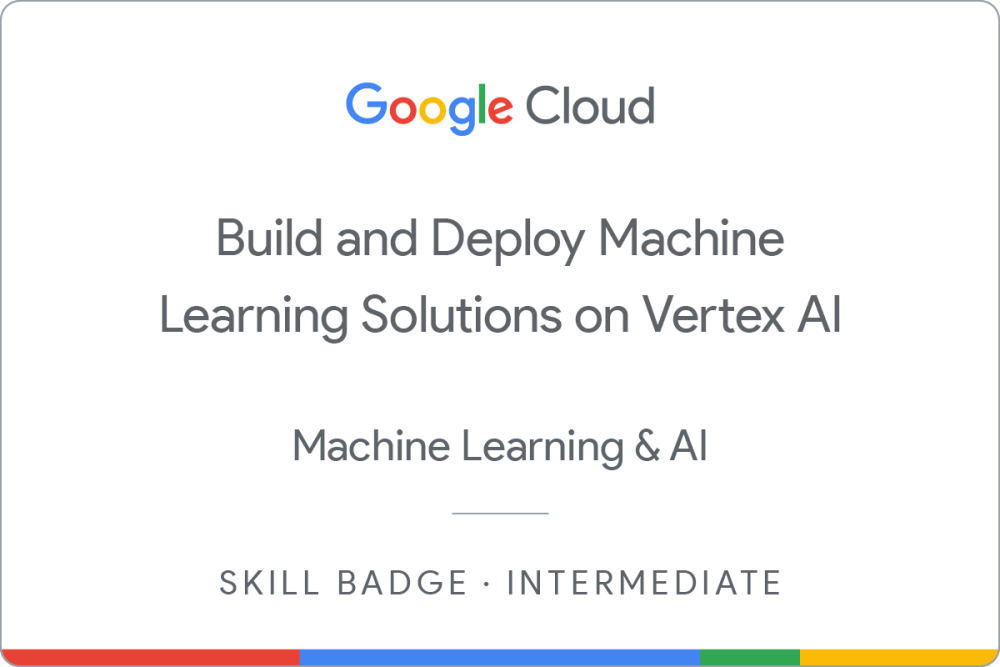 透過 Vertex AI 建構及部署機器學習解決方案
Earned Jun 28, 2024 EDT
透過 Vertex AI 建構及部署機器學習解決方案
Earned Jun 28, 2024 EDT
 Serverless Data Processing with Dataflow: Foundations
Earned Jun 27, 2024 EDT
Serverless Data Processing with Dataflow: Foundations
Earned Jun 27, 2024 EDT
 Building Resilient Streaming Systems on Google Cloud Platform
Earned Jun 21, 2024 EDT
Building Resilient Streaming Systems on Google Cloud Platform
Earned Jun 21, 2024 EDT
 Build Data Lakes and Data Warehouses on Google Cloud
Earned Jun 18, 2024 EDT
Build Data Lakes and Data Warehouses on Google Cloud
Earned Jun 18, 2024 EDT
 Preparing for your Professional Data Engineer Journey
Earned Jun 14, 2024 EDT
Preparing for your Professional Data Engineer Journey
Earned Jun 14, 2024 EDT
 Machine Learning Operations (MLOps): Getting Started
Earned Jun 13, 2024 EDT
Machine Learning Operations (MLOps): Getting Started
Earned Jun 13, 2024 EDT
 在 Google Cloud 為機器學習 API 準備資料
Earned Jun 13, 2024 EDT
在 Google Cloud 為機器學習 API 準備資料
Earned Jun 13, 2024 EDT
 Machine Learning Operations (MLOps) with Vertex AI: Manage Features
Earned Jun 10, 2024 EDT
Machine Learning Operations (MLOps) with Vertex AI: Manage Features
Earned Jun 10, 2024 EDT
 Recommendation Systems on Google Cloud
Earned Jun 7, 2024 EDT
Recommendation Systems on Google Cloud
Earned Jun 7, 2024 EDT
 Natural Language Processing on Google Cloud
Earned Jun 5, 2024 EDT
Natural Language Processing on Google Cloud
Earned Jun 5, 2024 EDT
 Production Machine Learning Systems
Earned May 30, 2024 EDT
Production Machine Learning Systems
Earned May 30, 2024 EDT
 Machine Learning in the Enterprise
Earned May 29, 2024 EDT
Machine Learning in the Enterprise
Earned May 29, 2024 EDT
 Feature Engineering
Earned May 28, 2024 EDT
Feature Engineering
Earned May 28, 2024 EDT
 Build, Train and Deploy ML Models with Keras on Google Cloud
Earned May 27, 2024 EDT
Build, Train and Deploy ML Models with Keras on Google Cloud
Earned May 27, 2024 EDT
 Integrate Vertex AI Search and Conversation into Voice and Chat Apps
Earned May 23, 2024 EDT
Integrate Vertex AI Search and Conversation into Voice and Chat Apps
Earned May 23, 2024 EDT
 Develop Advanced Enterprise Search and Conversation Applications
Earned May 21, 2024 EDT
Develop Advanced Enterprise Search and Conversation Applications
Earned May 21, 2024 EDT
 Custom Search with Embeddings in Vertex AI
Earned May 21, 2024 EDT
Custom Search with Embeddings in Vertex AI
Earned May 21, 2024 EDT
 圖像生成簡介
Earned May 16, 2024 EDT
圖像生成簡介
Earned May 16, 2024 EDT
 Generative AI Fundamentals - 繁體中文
Earned May 16, 2024 EDT
Generative AI Fundamentals - 繁體中文
Earned May 16, 2024 EDT
 Generative AI Explorer : Vertex AI
Earned May 15, 2024 EDT
Generative AI Explorer : Vertex AI
Earned May 15, 2024 EDT
 Vector Search 和嵌入
Earned May 15, 2024 EDT
Vector Search 和嵌入
Earned May 15, 2024 EDT
 Implementing Generative AI with Vertex AI
Earned May 15, 2024 EDT
Implementing Generative AI with Vertex AI
Earned May 15, 2024 EDT
 Text Prompt Engineering Techniques
Earned May 14, 2024 EDT
Text Prompt Engineering Techniques
Earned May 14, 2024 EDT
 Vertex AI Studio 簡介
Earned May 14, 2024 EDT
Vertex AI Studio 簡介
Earned May 14, 2024 EDT
 Generative AI for Business Leaders
Earned May 13, 2024 EDT
Generative AI for Business Leaders
Earned May 13, 2024 EDT
 負責任的 AI 技術:透過 Google Cloud 採用 AI 開發原則
Earned May 10, 2024 EDT
負責任的 AI 技術:透過 Google Cloud 採用 AI 開發原則
Earned May 10, 2024 EDT
 負責任的 AI 技術簡介
Earned May 10, 2024 EDT
負責任的 AI 技術簡介
Earned May 10, 2024 EDT
 大型語言模型簡介
Earned May 10, 2024 EDT
大型語言模型簡介
Earned May 10, 2024 EDT
 生成式 AI 簡介
Earned May 10, 2024 EDT
生成式 AI 簡介
Earned May 10, 2024 EDT
 建立圖像說明生成模型
Earned May 10, 2024 EDT
建立圖像說明生成模型
Earned May 10, 2024 EDT
 Transformer 和 BERT 模型
Earned May 9, 2024 EDT
Transformer 和 BERT 模型
Earned May 9, 2024 EDT
 編碼器-解碼器架構
Earned May 9, 2024 EDT
編碼器-解碼器架構
Earned May 9, 2024 EDT
 注意力機制
Earned May 9, 2024 EDT
注意力機制
Earned May 9, 2024 EDT
 Launching into Machine Learning
Earned May 2, 2024 EDT
Launching into Machine Learning
Earned May 2, 2024 EDT
 Google Cloud 的 AI 和機器學習服務簡介
Earned Apr 29, 2024 EDT
Google Cloud 的 AI 和機器學習服務簡介
Earned Apr 29, 2024 EDT