Before you begin
- Labs create a Google Cloud project and resources for a fixed time
- Labs have a time limit and no pause feature. If you end the lab, you'll have to restart from the beginning.
- On the top left of your screen, click Start lab to begin

Create a data store and search app
/ 15
Debug your agent
/ 25
Set and utilize session state
/ 25
Deploy to Agent Runtime
/ 25
Configure a frontend to query your agent
/ 10
Create a data store and search app
/ 15
Debug your agent
/ 25
Set and utilize session state
/ 25
Deploy to Agent Runtime
/ 25
Configure a frontend to query your agent
/ 10


Lab Information
| Lab Manual Last Updated Date | November 18, 2026 |
| Last Tested Date and Time | November 18, 2026, 05:06:22 |
| Completion in Last 24 Hours | 678 |
In this challenge lab, you demonstrate your ability to author and debug multi-agent applications using Agent Development Kit (ADK), ground an agent with an Agent Search data store, share session state across sub-agents, deploy your agent to Agent Runtime, configure service agent IAM permissions, and query your deployed agent from a Chainlit web app.
In a challenge lab you’re given a scenario and a set of tasks. Instead of following step-by-step instructions, you will use the skills learned from the labs in the quest to figure out how to complete the tasks on your own! An automated scoring system (shown on this page) will provide feedback on whether you have completed your tasks correctly.
When you take a challenge lab, you will not be taught new Google Cloud concepts. You are expected to extend your learned skills, like changing default values and reading and researching error messages to fix your own mistakes.
To score 100% you must successfully complete all tasks within the time period!
In this lab you will use a simulated version of the Google Cloud Console. This allows you to:
In this lab, you:
AgentTool) alongside Python function tools.ToolContext.state and retrieve values using optional session state key templating.
Cymbal Shops is an American retail chain headquartered in Minneapolis that sells housewares, electronics, and clothing.
Cymbal Shops has expanded into Europe and launched a new Paint Department. It plans to use its online presence to streamline how people shop for paint for DIY home renovation projects.
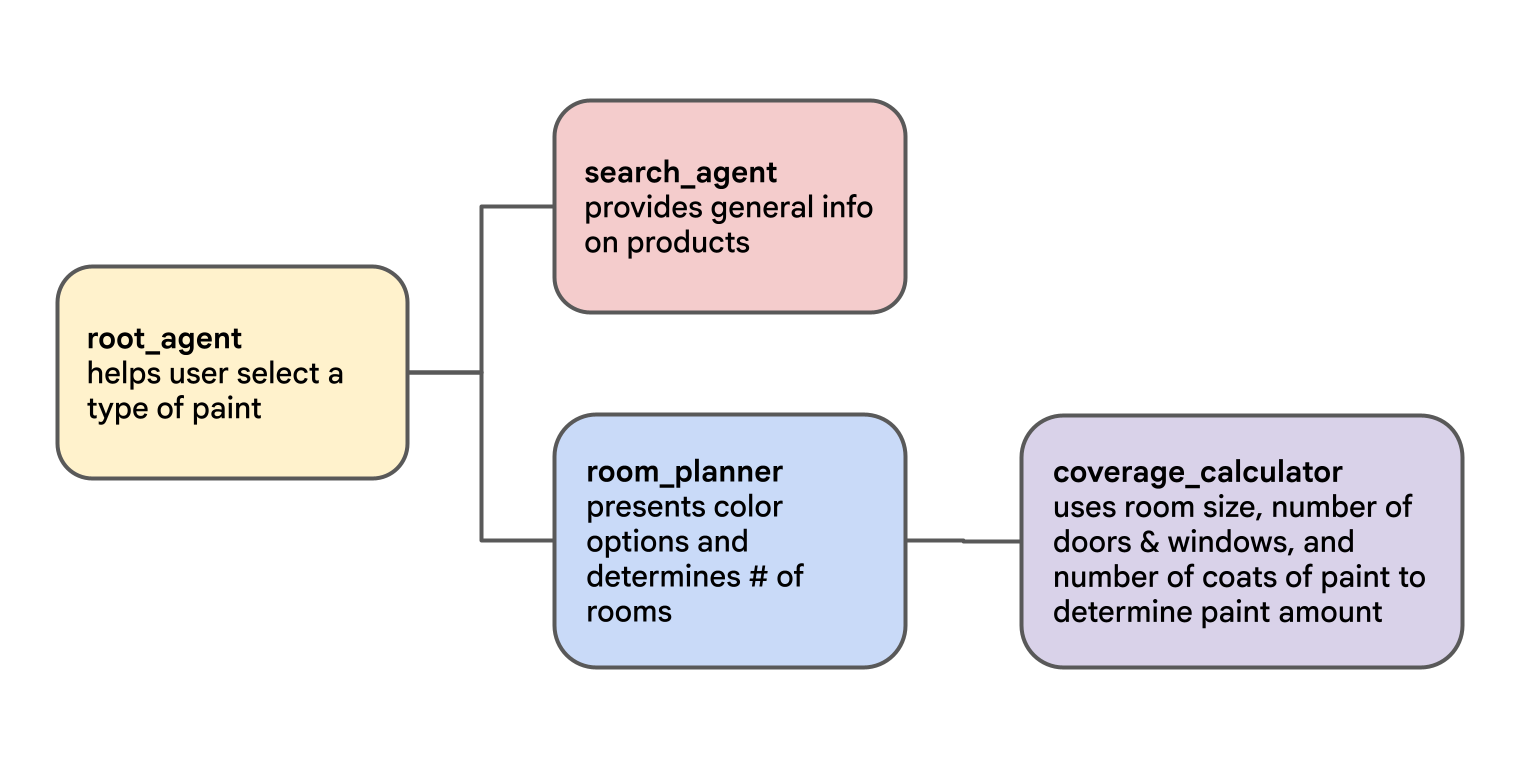
A coworker began developing Paint Agent to help customers:
Cymbal_Shops_Paint_Datasheets.pdf).Your coworker got stuck on a bug and left the organization. As a new ML Engineer at Cymbal Shops, you are tasked with completing and deploying Paint Agent:
Read these instructions. Labs are timed and you cannot pause them. The timer, which starts when you click Start Lab, shows how long Google Cloud resources are made available to you.
This hands-on lab lets you do the lab activities in a real cloud environment, not in a simulation or demo environment. It does so by giving you new, temporary credentials you use to sign in and access Google Cloud for the duration of the lab.
To complete this lab, you need:
During lab startup, Terraform provisioned a dedicated Cloud Run service (console-simulator) in your Google Cloud project (
Copy the Open Simulated Cloud Console URL from the left-hand lab panel and open it in a new browser tab:
Notice the companion Lab Steps panel on the right side of the simulator window, which tracks your steps across all tasks and provides click-to-copy values.
On the Sign in to your lab's simulated console page, sign in with your assigned Qwiklabs student credentials:
Click Sign in.
In the Welcome dialog inside the Simulated Cloud Console, select I agree to the Google Cloud Platform Terms of Service, click Agree and continue.
Select your assigned project
In this task, you deploy an Agent Search data store and search app inside the Simulated Cloud Console to import Cymbal Shops' paint datasheet (Cymbal_Shops_Paint_Datasheets.pdf) as the grounding data source for queries about Cymbal Shops paints.
In the Google Cloud console, navigate to Agent Platform > Agents > Search & RAG, then click Search App.
On the Agent Search page, click Create on the Custom search (general) card, configure your Search app with the following settings, and click Continue to proceed to 3 Data:
| Field | Value |
|---|---|
| App type | Custom search (general) |
| App name | Paint Search |
| Company name | Cymbal Shops |
| Location | global (Global) |
Click + Create Data Store and configure your Agent Search data store with the following settings:
| Field | Value |
|---|---|
| Data source |
Cloud Storage (Add data source) |
| Data type | Documents |
| Folder or File | File |
| File to import |
|
| Location | global |
| Data store name | Cymbal Paint |
| Document parser |
Layout Parser (expand Document processing options) |
| Enable table annotation | Enabled |
| Include ancestor headings in chunks | Enabled |
| Pricing model |
General pricing (click Create) |
Back on Create Search App > 3 Data, ensure the Cymbal Paint data store checkbox is selected and click Continue.
On 4 Pricing, keep General pricing selected and click Create to launch your Paint Search app.
Click Check my progress to verify the objective.
Click Activate Cloud Shell (>_) in the top-right bar of the Simulated Cloud Console, click Authorize in the Authorize Cloud Shell dialog, and click Open in new window (
On the Cloud Shell Editor Welcome tab, click Open Home Directory (or select File > Open Home Directory) to open your home directory in the Explorer.
Run the following command in the Cloud Shell Terminal to copy the starter files from Cloud Storage:
Update your PATH environment variable and install chainlit and the ADK project requirements in the Cloud Shell Terminal:
Copy the following commands to a text file, replace YOUR_ID with the ID of the Paint Search app you created in Task 1 (found in AI Applications > Apps inside the Simulated Cloud Console), and run the edited commands in the Cloud Shell Terminal to create ~/adk_challenge_lab/.env:
Note: To view hidden files beginning with a period (such as
.env) in Cloud Shell Editor, select View > Toggle Hidden Files in the editor menu bar.
Copy .env into the paint_agent directory so your agent includes its configuration once deployed:
In the Cloud Shell Terminal (~/adk_challenge_lab), run the current version of the agent:
When the [user]: prompt appears, enter hello and then yes. Observe the error output:
Open adk_challenge_lab/paint_agent/agent.py and explore paint_agent/sub_agents/ in Cloud Shell Editor to uncover which sub-agent invokes VertexAiSearchTool.
Because a search tool cannot be combined directly with non-search tools (including implicit transfer_to_agent sub-agent transfers), ADK provides AgentTool to wrap an isolated search agent as a tool:
adk_challenge_lab/paint_agent/agent.py, wrap that isolated search sub-agent in an AgentTool() inside root_agent's tools list, setting agent to the sub-agent you uncovered and skip_summarization to False.root_agent's sub_agents list.In the Cloud Shell Terminal, run adk run paint_agent again, ask the agent for the prices of EcoGreens and Forever Paint (for example, What are the prices of EcoGreens and Forever Paint?, verifying they are €35.00 and €40.00 per 2.5L container), and then type exit to end the CLI conversation.
Click Check my progress to verify the objective.
Your root_agent imports and uses set_session_value from adk_challenge_lab/paint_agent/tools.py to store SELECTED_PAINT, COVERAGE_RATE, and PRICE in the session state dictionary, but it is not yet implemented.
Open adk_challenge_lab/paint_agent/tools.py in Cloud Shell Editor:
key-value pairs in tool_context's state dictionary.'status' has value f"stored '{value}' in '{key}'" ({"status": f"stored '{value}' in '{key}'"}).Open adk_challenge_lab/paint_agent/sub_agents/room_planner/sub_agents/coverage_calculator/agent.py:
ALL CAPS placeholders (COVERAGE_RATE and PRICE) with ADK optional key templating syntax (for example, {SELECTED_PAINT?}) so the agent loads session state values safely.Launch the ADK Dev UI from ~/adk_challenge_lab (--allow_origins allows Cloud Shell's dynamic *.cloudshell.dev Web Preview proxy origin to communicate with the local ADK server):
Click http://127.0.0.1:8000 in the terminal output (or Web Preview > Preview on port 8000), click Select an app and choose paint_agent, and have the following conversation:
| You | Agent Response |
|---|---|
hello |
Offers to share information about Cymbal Shops' paints. |
yes |
Shares information about EcoGreens, Forever Paint, Project Paint, and SureCoverage. |
I'd like to use EcoGreens |
Updates the State tab (SELECTED_PAINT, COVERAGE_RATE, PRICE), renders the EcoGreens swatches, and asks how many rooms and their names. |
Just one room, my office |
Asks you to select a color for your office. |
Deep Ocean |
Transfers to coverage_calculator_agent and asks for room dimensions. |
3m by 4m. 3m high. 1 door, 2 windows. |
Estimates 37 square meters for one coat and asks to confirm two coats. |
Two coats. |
Calculates 74 square meters (7.4 liters, 3 buckets, 105.00 €). |
Switch back to the Cloud Shell tab and press Ctrl+C (or click Stop Server (Ctrl+C)) to shut down the server.
Click Check my progress to verify the objective.
In the Cloud Shell Terminal, verify you are in ~/adk_challenge_lab:
Deploy Paint Agent to Agent Runtime using adk deploy agent_engine with the following arguments:
| Parameter | Argument |
|---|---|
--display_name |
"Paint Agent" |
| Final positional argument | The directory of the agent you are deploying |
Switch to the Google Cloud console tab inside the simulator and navigate to IAM & Admin > IAM:
gcp-sa-aiplatform Vertex AI Service Agent without -re!).Return to Cloud Shell and note the deployed agent engine resource name (projects/.../locations/<REGION>/reasoningEngines/...) printed to the terminal.
Click Check my progress to verify the objective.
In Cloud Shell Editor, open adk_challenge_lab/chainlit_ui/app.py and replace YOUR_AGENT_RESOURCE_NAME in the line below with your deployed agent's resource name from the Cloud Shell Terminal output:
Run the Chainlit frontend from ~/adk_challenge_lab/chainlit_ui:
Click http://localhost:8000 in the terminal output to open the Cymbal Shops Paint Dept. tab, and have the following conversation with your deployed agent:
| You | Agent Response |
|---|---|
hello |
Offers to share information about Cymbal Shops' paints. |
yes |
Shares information about EcoGreens, Forever Paint, Project Paint, and SureCoverage. |
I'd like to use Forever Paint |
Displays the Forever Paint color swatches and asks how many rooms and their names. |
Two rooms. The living room and a baby's room. |
Asks you to pick a color for each room. |
"Sunlight through a canvas tent" for the baby's room and "Coffee Cream" for the living room. |
Requests dimensions for the living room. |
The living room is 5m by 4m. 2.5m high. 1 door, 3 windows. |
Estimates 38.5 square meters for one coat and asks how many coats to apply. |
Always two coats. |
Calculates 77 square meters (4 buckets, €160.00) for the living room, notes your two-coat preference, and requests dimensions for the baby's room. |
The baby's room is 3m by 3m. 2.5m high. 1 door, 1 window. |
Calculates 26.5 square meters for one coat and 53 square meters (3 buckets, €120.00) for two coats (7 buckets / €280.00 total). |
Click Check my progress to verify the objective.
In this lab, you have:
AgentTool alongside Python function tools.When you have completed your lab, click End Lab. Qwiklabs removes the resources you’ve used and cleans the account for you.
You will be given an opportunity to rate the lab experience. Select the applicable number of stars, type a comment, and then click Submit.
The number of stars indicates the following:
You can close the dialog box if you don't want to provide feedback.
For feedback, suggestions, or corrections, please use the Support tab.
Copyright 2026 Google LLC. All rights reserved. Google and the Google logo are trademarks of Google LLC. All other company and product names may be trademarks of the respective companies with which they are associated.


This content is not currently available
We can notify you via email when it becomes available
Great!
We can contact you via email if it becomes available

One lab at a time
Confirm to end all existing labs and start this one