Instructions et exigences de configuration de l'atelier
Protégez votre compte et votre progression. Utilisez toujours une fenêtre de navigation privée et les identifiants de l'atelier pour exécuter cet atelier.
Ce contenu n'est pas encore optimisé pour les appareils mobiles.
Pour une expérience optimale, veuillez accéder à notre site sur un ordinateur de bureau en utilisant un lien envoyé par e-mail.
This lab was developed with our partner, NetApp. Your personal information may be shared with NetApp, the lab sponsor, if you have opted-in to receive product updates, announcements, and offers in your Account Profile.
GSP1261
Overview
Google Cloud NetApp Volumes is a fully managed data storage service that lets you move file-based applications to Google Cloud. It has support for Network File System (NFSv3 and NFSv4.1) and Server Message Block (SMB) protocols built-in, so you don't need to re-architect your applications and can continue to get persistent storage for your applications.
In this lab you will learn how to create and mount an NFSv3 volume.
Read these instructions. Labs are timed and you cannot pause them. The timer, which starts when you click Start Lab, shows how long Google Cloud resources will be made available to you.
This Qwiklabs hands-on lab lets you do the lab activities yourself in a real cloud environment, not in a simulation or demo environment. It does so by giving you new, temporary credentials that you use to sign in and access Google Cloud for the duration of the lab.
What you need
To complete this lab, you need:
Access to a standard internet browser (Chrome browser recommended).
Time to complete the lab.
Note: If you already have your own personal Google Cloud account or project, do not use it for this lab.
Note: If you are using a Pixelbook, open an Incognito window to run this lab.
How to start your lab and sign in to the Google Cloud Console
Click the Start Lab button. If you need to pay for the lab, a pop-up opens for you to select your payment method.
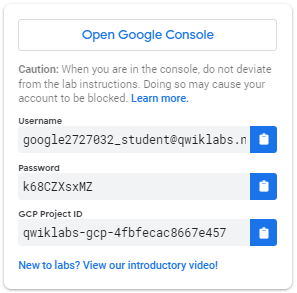
On the left is a panel populated with the temporary credentials that you must use for this lab.
Copy the username, and then click Open Google Console.
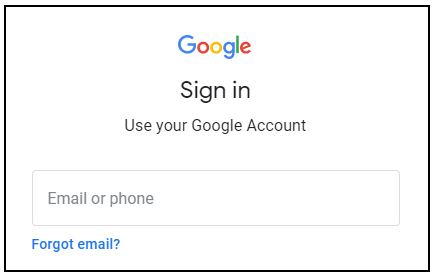
The lab spins up resources, and then opens another tab that shows the Sign in page.
Tip: Open the tabs in separate windows, side-by-side.
In the Sign in page, paste the username that you copied from the Connection Details panel. Then copy and paste the password.
Important: You must use the credentials from the Connection Details panel. Do not use your Qwiklabs credentials. If you have your own Google Cloud account, do not use it for this lab (avoids incurring charges).
Click through the subsequent pages:
Accept the terms and conditions.
Do not add recovery options or two-factor authentication (because this is a temporary account).
Do not sign up for free trials.
After a few moments, the Cloud Console opens in this tab.
Activate Cloud Shell
Cloud Shell is a virtual machine that is loaded with development tools. It offers a persistent 5GB home directory and runs on the Google Cloud. Cloud Shell provides command-line access to your Google Cloud resources.
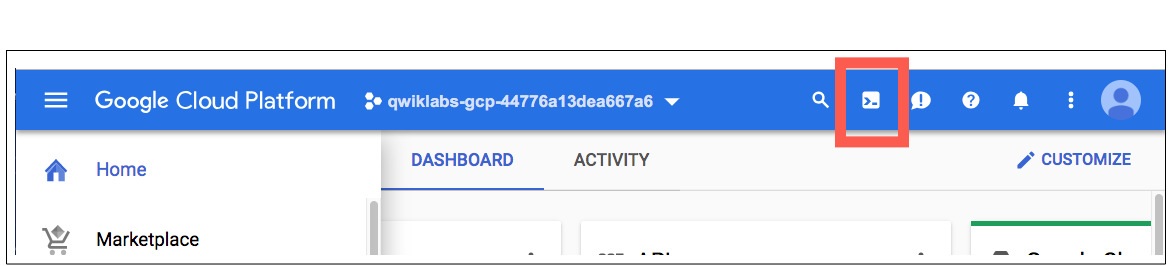
In the Cloud Console, in the top right toolbar, click the Activate Cloud Shell button.
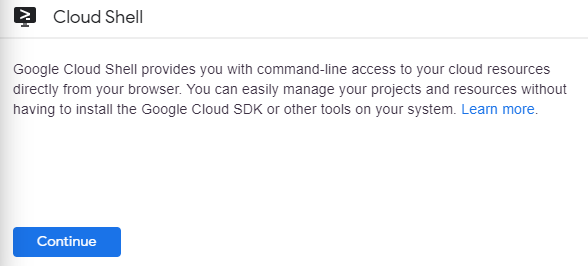
Click Continue.
It takes a few moments to provision and connect to the environment. When you are connected, you are already authenticated, and the project is set to your PROJECT_ID. For example:
gcloud is the command-line tool for Google Cloud. It comes pre-installed on Cloud Shell and supports tab-completion.
You can list the active account name with this command:
Storage pools act as containers for volumes. All volumes in a storage pool share the following information:
Location
Service level
Virtual Private Cloud (VPC) network
Active Directory policy
LDAP use for NFS volumes, if applicable
Customer-managed encryption key (CMEK) policy
Zonal or regional pool availability
In the Google Cloud console search bar (), type NetApp Volumes and select the result to open the service.
Click the Enable button for the NetApp API.
In the navigation pane, click Storage pools.
Click Create.
Create the storage pool using the following information:
For Storage pool name, type pool1
Under Location, for Region, select
Under Service level, select Premium
For Capacity, type 2048
Under Set up connections, for Network, select default
NetApp Volumes uses Private Service Access to communicate with your project resources. To enable this, you must first establish a connection.
Under Private services access connection required, click Set up connection.
For Allocate an IP range, select Use an automatically allocated IP range, then click Continue.
Click Create connection.
Note:
This process can take several minutes.
Once the connection is established, continue with the storage pool configuration.
Under Active Directory policy, uncheck Assign an Active Directory policy to...
Skip the remaining options and then click Create.
Note:
This process can take several minutes. If the Status column continues to show Creating, periodically click Refresh to update the view.
Click Check my progress to verify that you've performed the above task.
Create a storage pool
Task 2. Create a volume
A volume is a file system container in a storage pool that stores applications, databases, and user data.
In the navigation pane, click Volumes, then click Create.
Create the volume using the following information:
For Volume name, type volume1
Under Storage pool details, click Select storage pool, then select pool1
Under Volume details, set the Share name to share1 and the Capacity to 100
Under Protocol(s) configuration, set Protocol(s) to NFSv3
Under Configuration for selected protocol(s), ensure Block volume from deletion when clients are connected is unchecked.
Expand the Export rules section, then click Add Rule.
Create a rule using the following information:
For Allowed Clients, type 10.128.0.0/9
For Access, select Read & Write
For Root Access, select On
Click Done.
Skip the remaining options and click Create.
Note:
This process can take several minutes. If the Status column continues to show Creating, periodically click Refresh to update the view.
Click Check my progress to verify that you've performed the above task.
Create a volume
Task 3. Mount the volume
In the navigation pane, click Volumes.
Open Compute Engine → VM Instances in a new browser tab and click the SSH button for vm1.
Return to the NetApp Volumes page. In the row for the volume (volume1), click the overflow menu (), then select Mount Instructions.
Run the following commands from the Mount instructions into the SSH terminal in the following order:
Install the nfs utilities on the Linux VM:
sudo apt-get install nfs-common -y
Create a directory in the VM:
sudo mkdir /share1
Mount the volume by copying the sudo mount command from the Mount instructions and running it in the SSH terminal. The command includes the unique IP address of the volume. It will look like the command below:
sudo mount -t nfs -o rw,hard,rsize=65536,wsize=65536,vers=3,tcp <IP_ADDRESS>:/share1 /share1
Note: Please run the mount command exactly as it appears in your specific Mount instructions panel, as the IP address in this command is unique to your volume.
Verify that the volume has been mounted to your VM successfully:
df -h | grep share1
Click Check my progress to verify that you've performed the above task.
Mount the volume
Congratulations!
You have learned how to successfully create a volume within a storage pool and mount a NFS volume from a Linux virtual machine.
Next steps / Learn more
Be sure to check out the official NetApp Volumes documentation:
...helps you make the most of Google Cloud technologies. Our classes include technical skills and best practices to help you get up to speed quickly and continue your learning journey. We offer fundamental to advanced level training, with on-demand, live, and virtual options to suit your busy schedule. Certifications help you validate and prove your skill and expertise in Google Cloud technologies.
Manual last updated January 5, 2026
Manual Last tested January 5, 2026
Copyright 2024 Google LLC All rights reserved. Google and the Google logo are trademarks of Google LLC. All other company and product names may be trademarks of the respective companies with which they are associated.
Les ateliers créent un projet Google Cloud et des ressources pour une durée déterminée.
Les ateliers doivent être effectués dans le délai imparti et ne peuvent pas être mis en pause. Si vous quittez l'atelier, vous devrez le recommencer depuis le début.
En haut à gauche de l'écran, cliquez sur Démarrer l'atelier pour commencer.
Utilisez la navigation privée
Copiez le nom d'utilisateur et le mot de passe fournis pour l'atelier
Cliquez sur Ouvrir la console en navigation privée
Connectez-vous à la console
Connectez-vous à l'aide des identifiants qui vous ont été attribués pour l'atelier. L'utilisation d'autres identifiants peut entraîner des erreurs ou des frais.
Acceptez les conditions d'utilisation et ignorez la page concernant les ressources de récupération des données.
Ne cliquez pas sur Terminer l'atelier, à moins que vous n'ayez terminé l'atelier ou que vous ne vouliez le recommencer, car cela effacera votre travail et supprimera le projet.
Ce contenu n'est pas disponible pour le moment
Nous vous préviendrons par e-mail lorsqu'il sera disponible
Parfait !
Nous vous contacterons par e-mail s'il devient disponible
Un atelier à la fois
Confirmez pour mettre fin à tous les ateliers existants et démarrer celui-ci
Utilisez la navigation privée pour effectuer l'atelier
Le meilleur moyen d'exécuter cet atelier consiste à utiliser une fenêtre de navigation privée. Vous éviterez ainsi les conflits entre votre compte personnel et le compte temporaire de participant, qui pourraient entraîner des frais supplémentaires facturés sur votre compte personnel.
Learn the basic concepts about Google Cloud NetApp Volumes by creating and mounting an NFSv3 volume
Durée :
1 min de configuration
·
Accessible pendant 40 min
·
Terminé après 40 min




 ), type NetApp Volumes and select the result to open the service.
 ), then select Mount Instructions.