

准备工作
- 实验会创建一个 Google Cloud 项目和一些资源,供您使用限定的一段时间
- 实验有时间限制,并且没有暂停功能。如果您中途结束实验,则必须重新开始。
- 在屏幕左上角,点击开始实验即可开始


A summarization baseline model in Agent Assist enables users to customize the content of the summary by selecting from the following predefined sections:
In this lab, you will configure a summarization baseline model and use it to summarize an example audio conversation.
In this lab, you learn how to
Read these instructions. Labs are timed and you cannot pause them. The timer, which starts when you click Start Lab, shows how long Google Cloud resources will be made available to you.
This Qwiklabs hands-on lab lets you do the lab activities yourself in a real cloud environment, not in a simulation or demo environment. It does so by giving you new, temporary credentials that you use to sign in and access Google Cloud for the duration of the lab.
To complete this lab, you need:
Note: If you already have your own personal Google Cloud account or project, do not use it for this lab.
Note: If you are using a Pixelbook, open an Incognito window to run this lab.
Click the Start Lab button. If you need to pay for the lab, a dialog opens for you to select your payment method. On the left is the Lab Details pane with the following:
Click Open Google Cloud console (or right-click and select Open Link in Incognito Window if you are running the Chrome browser).
The lab spins up resources, and then opens another tab that shows the Sign in page.
Tip: Arrange the tabs in separate windows, side-by-side.
If necessary, copy the Username below and paste it into the Sign in dialog.
You can also find the Username in the Lab Details pane.
Click Next.
Copy the Password below and paste it into the Welcome dialog.
You can also find the Password in the Lab Details pane.
Click Next.
Click through the subsequent pages:
After a few moments, the Google Cloud console opens in this tab.

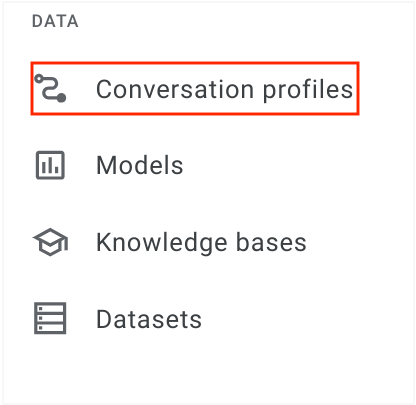
Navigate to Agent Assist Console. In the navigation menu, under Data, click on Conversation profiles. If asked, select the
At the top of the page, click the + Create button to create a new conversation profile.
For the conversation profile Display name, enter lab-conv-profile.
For Language, select en - English.
For Suggestion type, select Conversation summarization (legacy).
Scroll down to the bottom of the page and click Create to create your conversation profile.
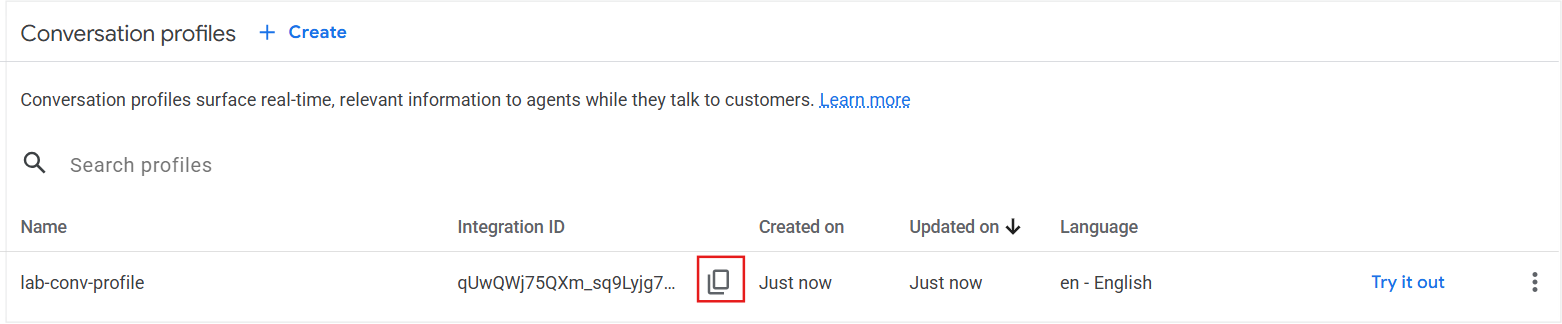
Click on the copy button to the right of the Integration ID column and record the integration ID somewhere you can reference later. Your integration ID should be similar in form to the following:
Return to the Google Cloud Console and type "Vertex AI Workbench" in the search bar, and then click Workbench Vertex AI in the resulting options.
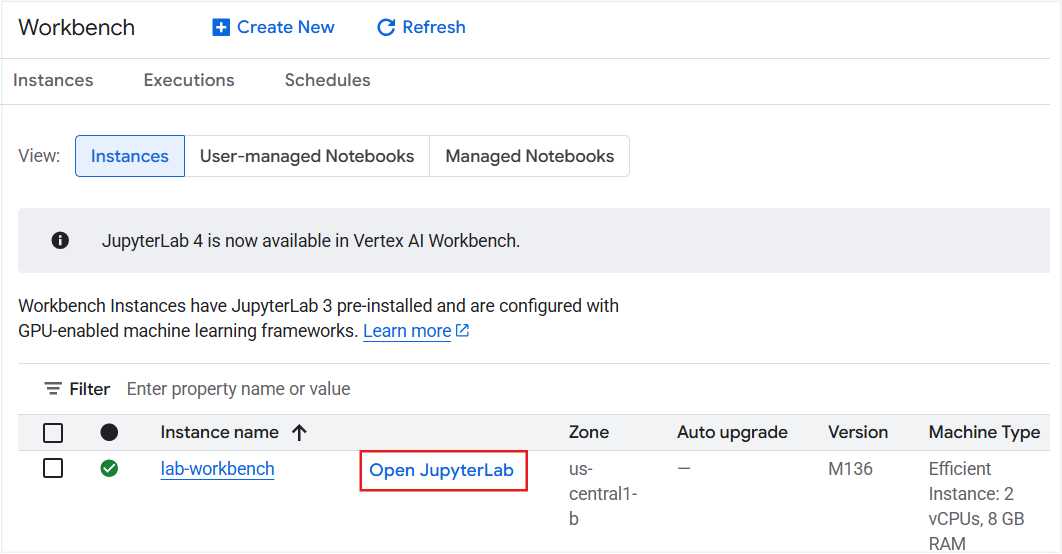
Click the Open JupyterLab button beside lab-workbench instance.
Once the JupyterLab opens in a new browser tab, click on the Terminal icon from Launcher. This will open up a new Terminal window.
Clone the repository containing the lab notebook by running the following command in the Terminal window:
In the file browser, navigate to the specialized-training-content > courses > agent_assist folder on the left hand side of the notebook.
Double click to open the baseline_summarization_audio.ipynb notebook.
In the Select Kernel dialog, select Python 3 from the list of available kernels, then click Select.
Click Kernel > Restart Kernel and Clear All Outputs. and then click Restart.
Follow the instructions in the notebook file, running the notebook one cell at a time. Be sure to keep an eye out for directions that ask you to update code in the cells.
In this lab you configured a summarization baseline model, redacted sensitive information using the Data Loss Prevention API, and used the conversation profile to summarize an example audio conversation.
When you have completed your lab, click End Lab. Qwiklabs removes the resources you’ve used and cleans the account for you.
You will be given an opportunity to rate the lab experience. Select the applicable number of stars, type a comment, and then click Submit.
The number of stars indicates the following:
You can close the dialog box if you don't want to provide feedback.
For feedback, suggestions, or corrections, please use the Support tab.
Copyright 2023 Google LLC All rights reserved. Google and the Google logo are trademarks of Google LLC. All other company and product names may be trademarks of the respective companies with which they are associated.


此内容目前不可用
一旦可用,我们会通过电子邮件告知您
太好了!
一旦可用,我们会通过电子邮件告知您

一次一个实验
确认结束所有现有实验并开始此实验