Pull data from censustract_2018_5y using the BigQuery data connector
Vérifier ma progression
/ 50
Pull data from censustract_2018_5yr_top10000_housingunits using the BigQuery data connector
Vérifier ma progression
/ 50
Instructions et exigences de configuration de l'atelier
Protégez votre compte et votre progression. Utilisez toujours une fenêtre de navigation privée et les identifiants de l'atelier pour exécuter cet atelier.
Pulling BigQuery Data into Google Sheets using BigQuery Connected Sheets
Ce contenu n'est pas encore optimisé pour les appareils mobiles.
Pour une expérience optimale, veuillez accéder à notre site sur un ordinateur de bureau en utilisant un lien envoyé par e-mail.
Overview
In this scenario, you are a data analyst with strong experience in Google Sheets but are new to BigQuery. You are employed with a solar energy company who is interested in identifying U.S. counties with the highest number of homeowners who can benefit from a new grant. The new United States (U.S.) federal grant is available to homeowners with homes built before 1960 and annual incomes below $60,000 USD. You know that the necessary data to identify these homeowners is in your company's BigQuery data warehouse and would like to analyze the BigQuery data in Google Sheets.
Through the BigQuery data connector in Google Sheets, Connected Sheets provides you with the ability to access, analyze, visualize, and share BigQuery data without the need for any SQL.
In this lab, you learn how to get started with BigQuery data in Google Sheets by using the BigQuery data connector to pull data from BigQuery tables (in a Google Cloud project) into Google Sheets.
Objectives
In this lab, you will learn how to perform the following tasks:
Open the BigQuery data connector in Google Sheets.
Connect to a BigQuery table and pull the data into a Google Sheet.
Setup
For each lab, you get a new Google Cloud project and set of resources for a fixed time at no cost.
Sign in to Google Skills using an incognito window.
Note the lab's access time (for example, 1:15:00), and make sure you can finish within that time.
There is no pause feature. You can restart if needed, but you have to start at the beginning.
When ready, click Start lab.
Note your lab credentials (Username and Password). You will use them to sign in to the Google Cloud Console.
Click Open Google Console.
Click Use another account and copy/paste credentials for this lab into the prompts.
If you use other credentials, you'll receive errors or incur charges.
Accept the terms and skip the recovery resource page.
Task 1. Open a new Google Sheet
In this first task, you log into Google Workspace in this lab environment using the provided credentials and then open a new Google Sheet.
To open Sheets, right-click this provided link for Open Google Sheets, and select the option to open the link in a new incognito window.
To sign into Google Workspace, use the credentials (username and password) provided on the current lab page.
Be sure to:
Accept the terms and conditions.
Do not add recovery options or two-factor authentication (because this is a temporary account).
Exit the Welcome to Google Sheets window.
Note: Be sure to log into Google Workspace using the provided lab credentials. If you use your personal Google Cloud account, you may incur charges when connecting to BigQuery and other Google Cloud resources.
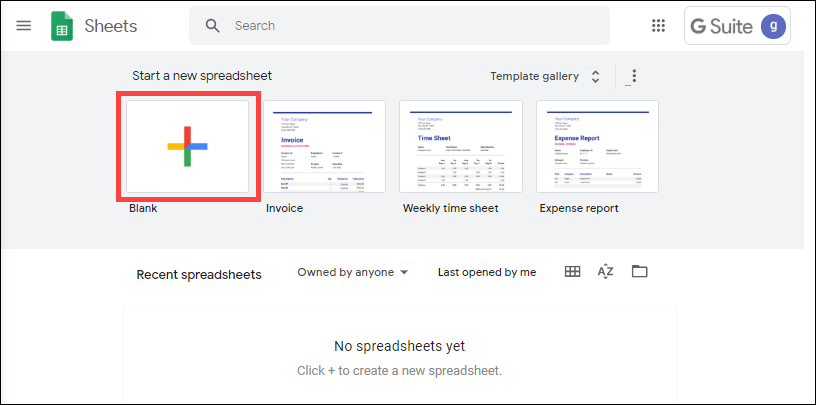
On the Sheets main page, click the + (plus sign) for Blank spreadsheet.
Task 2. Pull data using the BigQuery data connector
In BigQuery, a table ID contains all of the information needed to locate the table (including the names of the Google Cloud Project, the BigQuery dataset, and the table) and is structured as follows:
project_name.dataset_name.table_name
In this task, you use the BigQuery data connector to connect and pull the data from the following table in your lab-provided Google Cloud project into Google Sheets:
.public_sector.censustract_2018_5yr
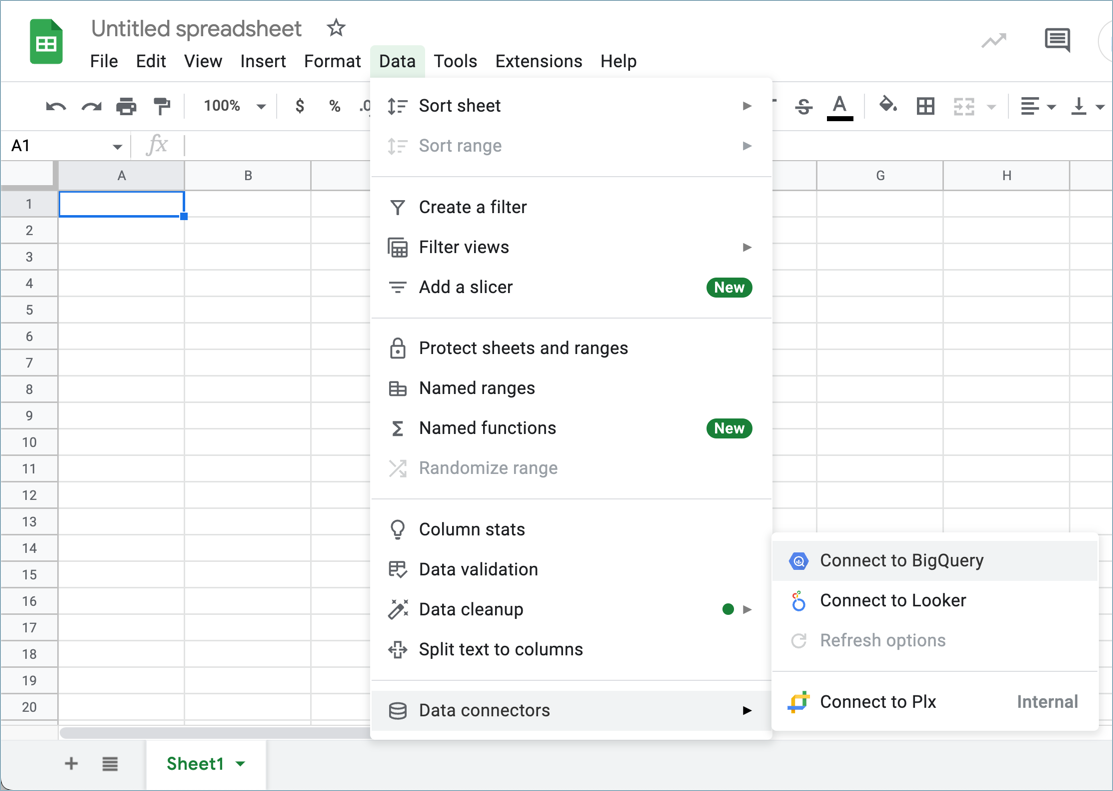
In the menu bar of your Google Sheet, select Data > Data connectors > Connect to BigQuery.
For Choose a cloud project, search for the project name.
For Choose a dataset, select public_sector.
For Choose a table or view, select censustract_2018_5yr.
Click Connect.
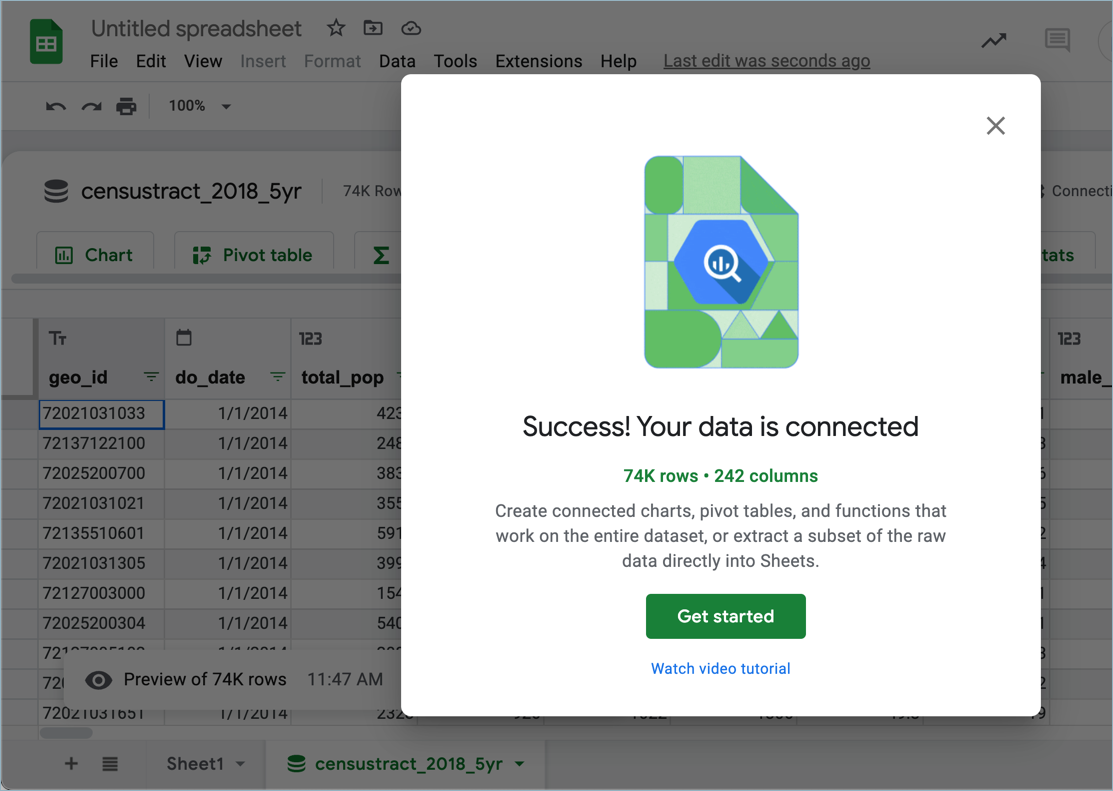
After a successful data connection, the data will populate the Google Sheet and resemble the following table structure with 74,000 records.
geo_id
do_date
total_pop
households
more columns...
72021031033
2014-01-01
4234
1536
...
72137122100
2014-01-01
2483
834
...
72025200700
2014-01-01
3832
1445
...
72021031021
2014-01-01
3555
1376
...
72135510601
2014-01-01
5915
1550
...
Click Check my progress to verify the objective.
Pull data from censustract_2018_5y using the BigQuery data connector
Challenge
Test your new skills by pulling in another BigQuery dataset into your Google Sheet.
For this challenge, repeat the lab tasks as needed to pull data from the following BigQuery table ID:
After a successful data connection, the data will populate the Google Sheet and have the same table structure as censustract_2018_5yr but only contain 10,000 records.
Click Check my progress to verify the objective.
Pull data from censustract_2018_5yr_top10000_housingunits using the BigQuery data connector
Congratulations!
You have successfully used the BigQuery data connector to pull data from a BigQuery table into your Google Sheet!
Last Tested Date: November 04, 2022
Last Updated Date: November 04, 2022
End your lab
When you have completed your lab, click End Lab. Google Skills removes the resources you’ve used and cleans the account for you.
You will be given an opportunity to rate the lab experience. Select the applicable number of stars, type a comment, and then click Submit.
The number of stars indicates the following:
1 star = Very dissatisfied
2 stars = Dissatisfied
3 stars = Neutral
4 stars = Satisfied
5 stars = Very satisfied
You can close the dialog box if you don't want to provide feedback.
For feedback, suggestions, or corrections, please use the Support tab.
Copyright 2026 Google LLC All rights reserved. Google and the Google logo are trademarks of Google LLC. All other company and product names may be trademarks of the respective companies with which they are associated.
Les ateliers créent un projet Google Cloud et des ressources pour une durée déterminée.
Les ateliers doivent être effectués dans le délai imparti et ne peuvent pas être mis en pause. Si vous quittez l'atelier, vous devrez le recommencer depuis le début.
En haut à gauche de l'écran, cliquez sur Démarrer l'atelier pour commencer.
Utilisez la navigation privée
Copiez le nom d'utilisateur et le mot de passe fournis pour l'atelier
Cliquez sur Ouvrir la console en navigation privée
Connectez-vous à la console
Connectez-vous à l'aide des identifiants qui vous ont été attribués pour l'atelier. L'utilisation d'autres identifiants peut entraîner des erreurs ou des frais.
Acceptez les conditions d'utilisation et ignorez la page concernant les ressources de récupération des données.
Ne cliquez pas sur Terminer l'atelier, à moins que vous n'ayez terminé l'atelier ou que vous ne vouliez le recommencer, car cela effacera votre travail et supprimera le projet.
Ce contenu n'est pas disponible pour le moment
Nous vous préviendrons par e-mail lorsqu'il sera disponible
Parfait !
Nous vous contacterons par e-mail s'il devient disponible
Un atelier à la fois
Confirmez pour mettre fin à tous les ateliers existants et démarrer celui-ci
Utilisez la navigation privée pour effectuer l'atelier
Le meilleur moyen d'exécuter cet atelier consiste à utiliser une fenêtre de navigation privée. Vous éviterez ainsi les conflits entre votre compte personnel et le compte temporaire de participant, qui pourraient entraîner des frais supplémentaires facturés sur votre compte personnel.
In this lab, you use the BigQuery data connector to pull data from BigQuery tables (in a Google Cloud project) into Google Sheets.
Durée :
0 min de configuration
·
Accessible pendant 30 min
·
Terminé après 30 min