准备工作
- 实验会创建一个 Google Cloud 项目和一些资源,供您使用限定的一段时间
- 实验有时间限制,并且没有暂停功能。如果您中途结束实验,则必须重新开始。
- 在屏幕左上角,点击开始实验即可开始

Copy Java files to the Cloud
/ 5
Submit the Dataflow job to the Cloud
/ 5

In this lab, you will open a Dataflow project, use pipeline filtering, and execute the pipeline locally and on the cloud.
In this lab, you learn how to write a simple Dataflow pipeline and run it both locally and on the cloud.
For each lab, you get a new Google Cloud project and set of resources for a fixed time at no cost.
Sign in to Google Skills using an incognito window.
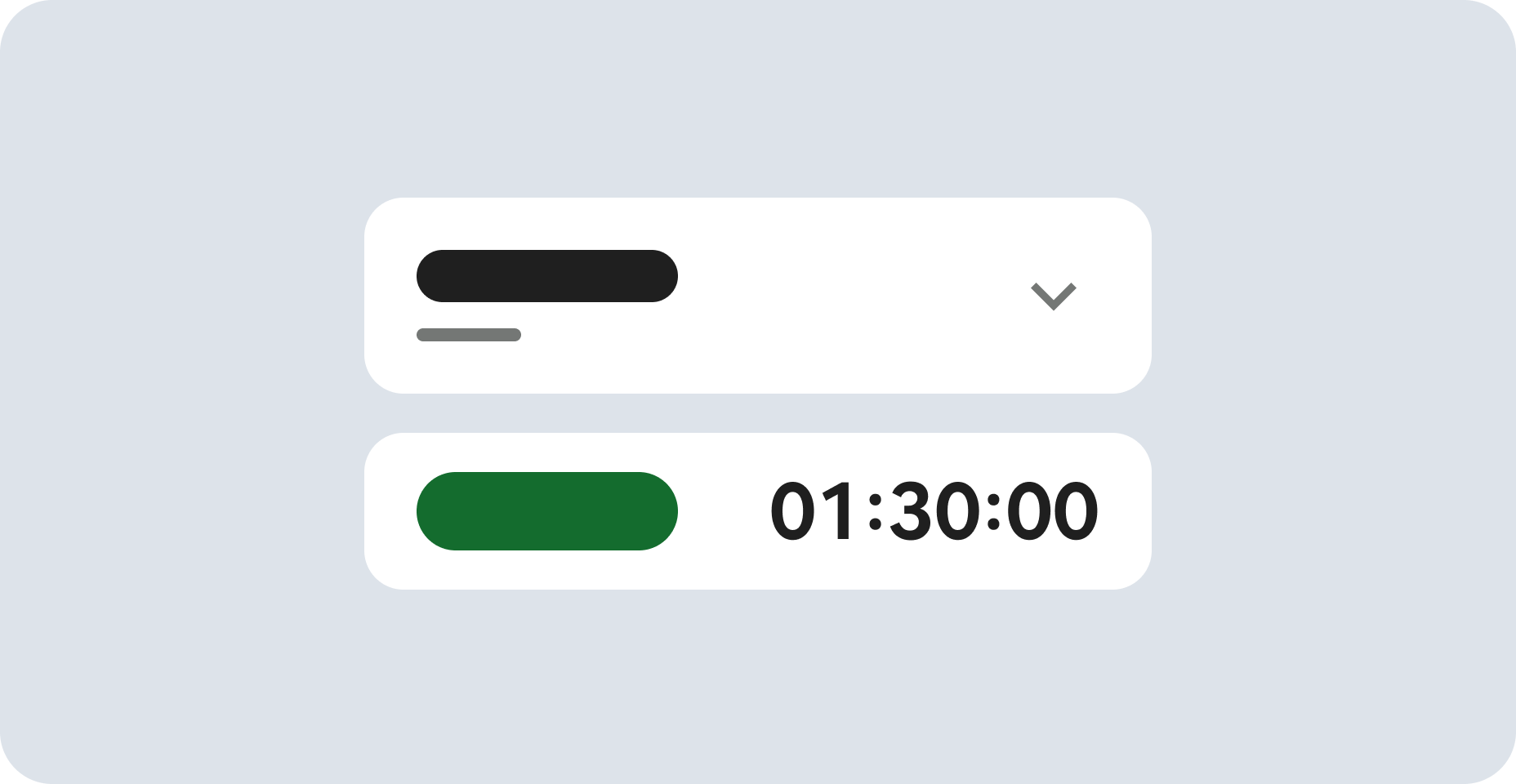
Note the lab's access time (for example, 1:15:00), and make sure you can finish within that time.
There is no pause feature. You can restart if needed, but you have to start at the beginning.
When ready, click Start lab.
Note your lab credentials (Username and Password). You will use them to sign in to the Google Cloud Console.
Click Open Google Console.
Click Use another account and copy/paste credentials for this lab into the prompts. If you use other credentials, you'll receive errors or incur charges.
Accept the terms and skip the recovery resource page.
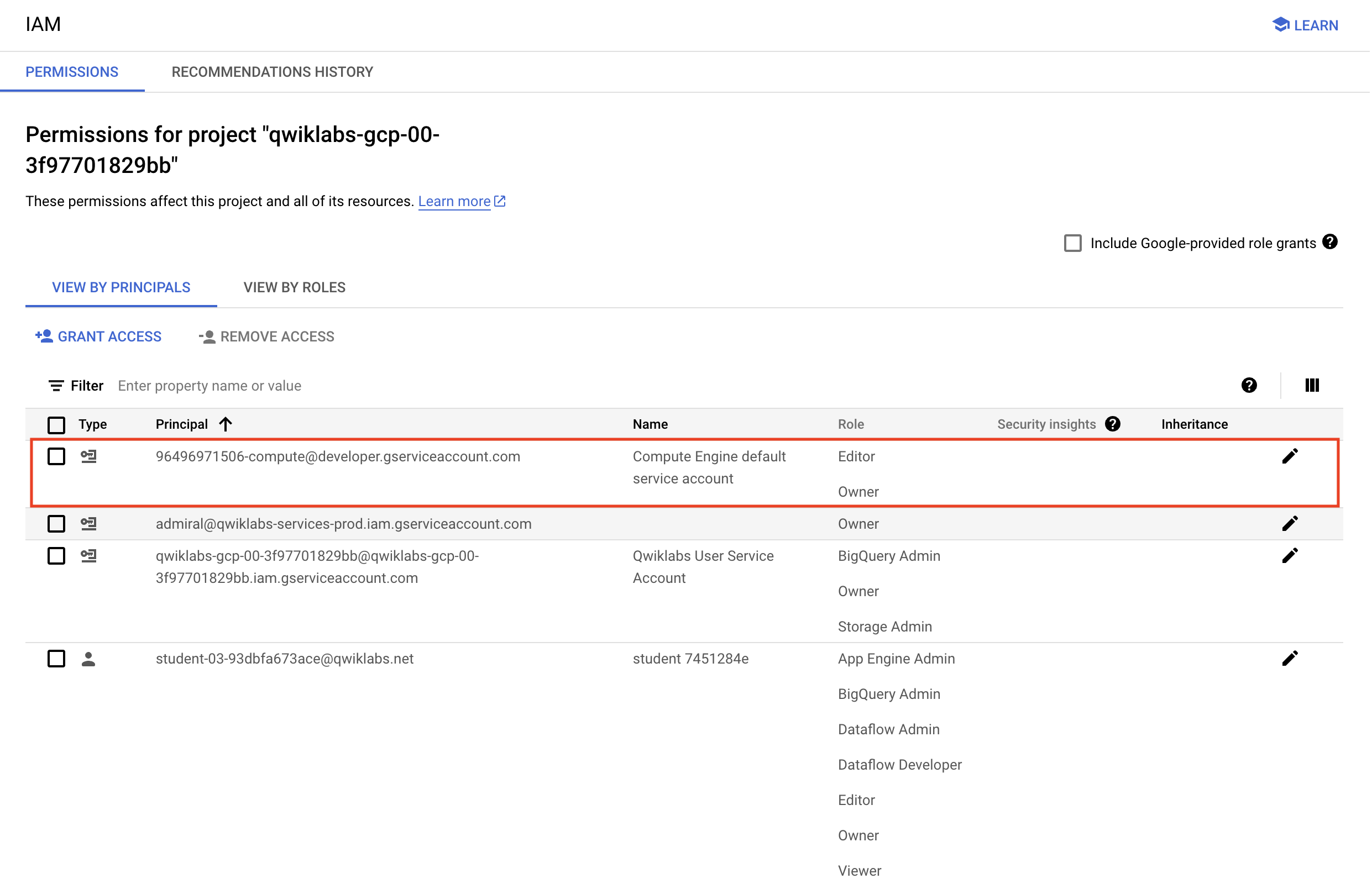
Before you begin your work on Google Cloud, you need to ensure that your project has the correct permissions within Identity and Access Management (IAM).
In the Google Cloud console, on the Navigation menu (
Confirm that the default compute Service Account {project-number}-compute@developer.gserviceaccount.com is present and has the editor role assigned. The account prefix is the project number, which you can find on Navigation menu > Cloud Overview > Dashboard.
editor role, follow the steps below to assign the required role.729328892908).{project-number} with your project number.To ensure access to the necessary API, restart the connection to the Dataflow API.
In the Cloud Console, enter Dataflow API in the top search bar.
Click on the result for Dataflow API.
Click Manage.
Click Disable API.
If asked to confirm, click Disable.
Click Enable.
You will be running all code from a curated training VM.
In the Console, expand the Navigation menu (
Locate the line with the instance called training-vm.
On the far right, under Connect, click on SSH to open a terminal window.
In this lab, you will enter CLI commands on the training-vm.
sudo apt-get update and then, sudo apt-get -y install git Follow these instructions to create a bucket.
In the Console, on the Navigation menu, click Cloud overview.
Select and copy the Project ID.
For simplicity you will use the Google Skills Project ID, which is already globally unique, as the bucket name.
| Property | Value (type value or select option as specified) |
|---|---|
| Name | <your unique bucket name (Project ID)> |
| Location type | Multi-Region |
| Location | <Your location> |
Click Create.
Record the name of your bucket. You will need it in subsequent tasks.
In the training-vm SSH terminal enter the following to create an environment variable named "BUCKET" and verify that it exists with the echo command:
You can use $BUCKET in terminal commands. And if you need to enter the bucket name <your-bucket> in a text field in Console, you can quickly retrieve the name with echo $BUCKET.
The goal of this lab is to become familiar with the structure of a Dataflow project and learn how to execute a Dataflow pipeline.
Return to the training-vm SSH terminal and navigate to the directory /training-data-analyst/courses/data_analysis/lab2/python and view the file grep.py.
View the file with Nano. Do not make any changes to the code.
Can you answer these questions about the file grep.py?
There are three transforms in the pipeline:
grep.py:The output file will be output.txt. If the output is large enough, it will be sharded into separate parts with names like: output-00000-of-00001.
Examine the output file(s).
You can replace "-*" below with the appropriate suffix:
Does the output seem logical?
Click Check my progress to verify the objective.
grepc.py:Example strings before:
Example strings after edit (use your values):
Save the file and close Nano by pressing the CTRL+X key, then press Y, and Enter.
Submit the Dataflow job to the cloud:
Because this is such a small job, running on the cloud will take significantly longer than running it locally (on the order of 7-10 minutes).
Return to the browser tab for Console.
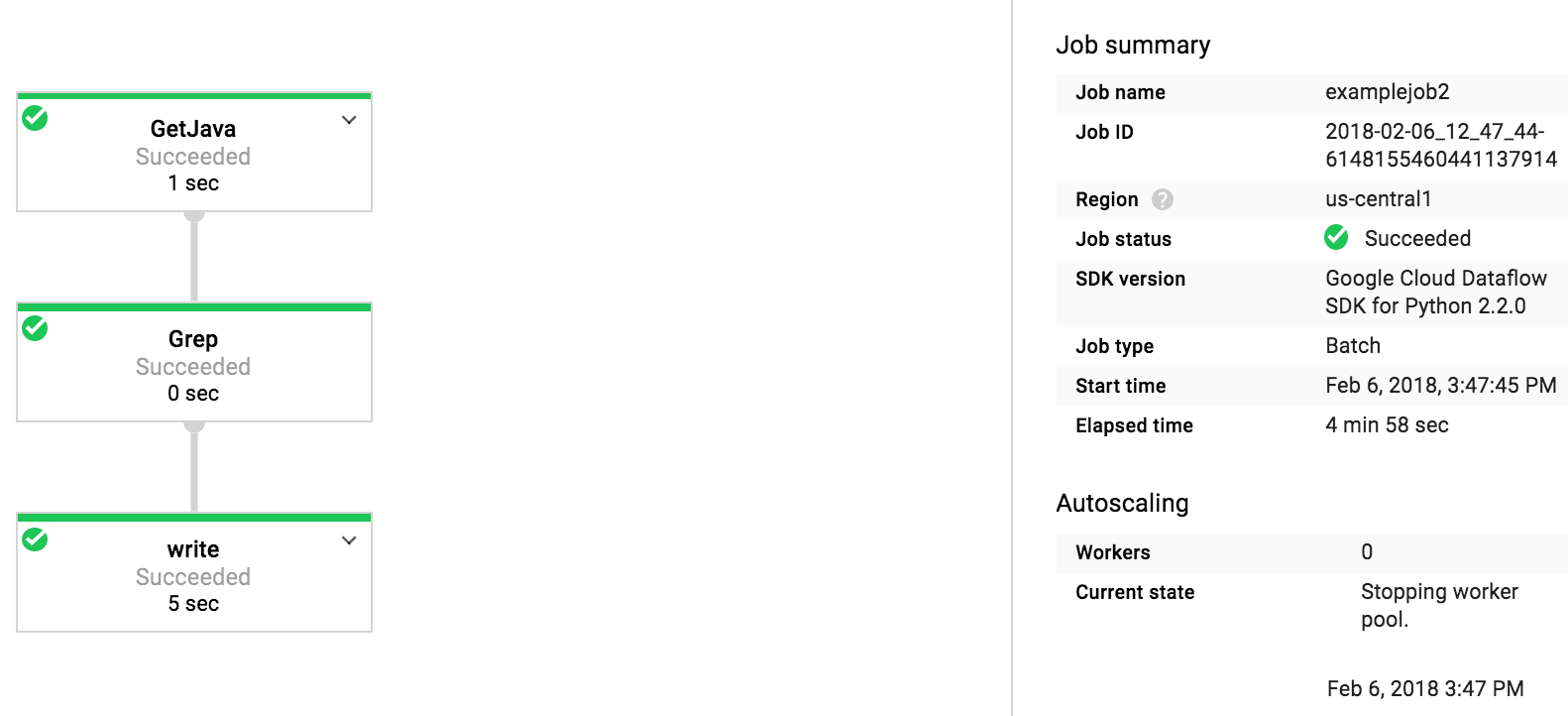
On the Navigation menu, click Dataflow and click on your job to monitor progress.
Example:
Click Check my progress to verify the objective.
Examine the output in the Cloud Storage bucket.
On the Navigation menu, click Cloud Storage > Buckets and click on your bucket.
Click the javahelp directory.
This job will generate the file output.txt. If the file is large enough it will be sharded into multiple parts with names like: output-0000x-of-000y. You can identify the most recent file by name or by the Last modified field.
Alternatively, you can download the file via the training-vm SSH terminal and view it:
When you have completed your lab, click End Lab. Google Skills removes the resources you’ve used and cleans the account for you.
You will be given an opportunity to rate the lab experience. Select the applicable number of stars, type a comment, and then click Submit.
The number of stars indicates the following:
You can close the dialog box if you don't want to provide feedback.
For feedback, suggestions, or corrections, please use the Support tab.
Copyright 2026 Google LLC All rights reserved. Google and the Google logo are trademarks of Google LLC. All other company and product names may be trademarks of the respective companies with which they are associated.


此内容目前不可用
一旦可用,我们会通过电子邮件告知您
太好了!
一旦可用,我们会通过电子邮件告知您

一次一个实验
确认结束所有现有实验并开始此实验