
准备工作
- 实验会创建一个 Google Cloud 项目和一些资源,供您使用限定的一段时间
- 实验有时间限制,并且没有暂停功能。如果您中途结束实验,则必须重新开始。
- 在屏幕左上角,点击开始实验即可开始

Verify that the Active Directory secret was created
/ 30
Verify that the SQl Server user secret was created
/ 30
Verify SQL cluster was deployed
/ 40

In this hands-on lab, you learn how to deploy your SQL Server Always On availability group cluster using Workload Manager Guided Deployment Automation for SQL Server.
Workload Manager Guided Deployment Automation for SQL Server is a feature within Google Cloud's Workload Manager service. It's designed to simplify and accelerate the process of deploying SQL Server workloads on the Google Cloud Platform. Instead of manually configuring infrastructure and software, this tool provides a guided interface to define your requirements, and then it automates the deployment based on best practices.
Read these instructions. Labs are timed and you cannot pause them. The timer, which starts when you click Start Lab, shows how long Google Cloud resources are made available to you.
This hands-on lab lets you do the lab activities in a real cloud environment, not in a simulation or demo environment. It does so by giving you new, temporary credentials you use to sign in and access Google Cloud for the duration of the lab.
To complete this lab, you need:
Click the Start Lab button. If you need to pay for the lab, a dialog opens for you to select your payment method. On the left is the Lab Details pane with the following:
Click Open Google Cloud console (or right-click and select Open Link in Incognito Window if you are running the Chrome browser).
The lab spins up resources, and then opens another tab that shows the Sign in page.
Tip: Arrange the tabs in separate windows, side-by-side.
If necessary, copy the Username below and paste it into the Sign in dialog.
You can also find the Username in the Lab Details pane.
Click Next.
Copy the Password below and paste it into the Welcome dialog.
You can also find the Password in the Lab Details pane.
Click Next.
Click through the subsequent pages:
After a few moments, the Google Cloud console opens in this tab.

In this task, you create a secret and store the Active Directory account password in Secret Manager.
In the Google Cloud console, in the Navigation menu (
Click Create Secret.
For Name, type ad-secret.
For Secret value, type or paste the following:
Click Check my progress to verify the objective.
Create a secret and store the SQL Server account password.
Return to the Secret Manager page and click Create Secret.
For Name, type sql-secret.
For Secret value, type or paste the following:
Click Check my progress to verify the objective.
In this section, you use Guided Deployment Automation to deploy an SQL Server cluster.
On the Google Cloud console title bar, type Workload Manager in the Search field.
In the left pane, click Deployments.
Click Create Deployment
For workload type, click CHOOSE SQL SERVER
On the Missing service account roles page, click Grant to assign the required roles to the service account.
Setting |
Value |
Deployment name |
sqlserver-lab |
Deployment description |
SQL Server deployment lab |
Service account |
Compute Engine default service account - Click **Grant** button if prompted. |
Service account for Compute Engine |
Compute Engine default service account - Click **Grant** if prompted. |
Environment |
Production |
Operating System |
Windows |
Windows licensing type |
Pay-as-you-go (PAYG) |
SQL licensing type |
Pay-as-you-go (PAYG) |
OS image |
Public image SQL Server 2019 Standard, on Windows Server 2019 Datacenter, x64 built on 20240613 |
Deployment strategy |
High Availability |
Availability mode |
Availability group (AG) |
VM name prefix |
sqllab |
Setting |
Value |
Region |
|
Primary zone |
|
Secondary zone |
|
Tertiary zone |
|
Network |
default |
Subnetwork |
default |
Internet access |
Cloud NAT |
DNS zone |
Create a new DNS zone |
Setting |
Value |
Secret name for Active Directory |
ad-secret |
Domain username |
administrator |
Active Directory IP address |
Internal IP address of the lab-dc-1 instance. |
Domain DNS Name |
wlmlab.local |
Setting |
Value |
Secret name for Database Credentials |
sql-secret |
Tenancy model |
Shared |
Machine Type |
n2-standard-2 |
Click Continue.
Review all the options and click Create.
Click Check my progress to verify the objective.
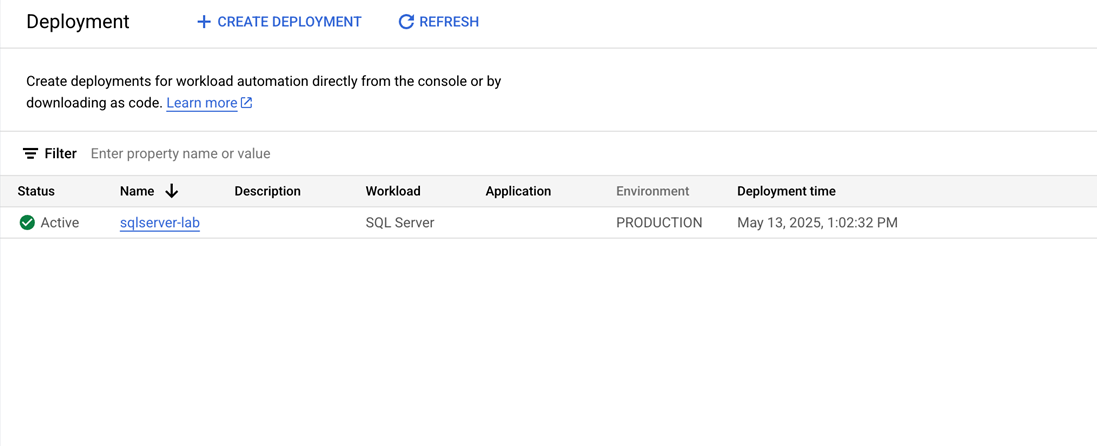
The deployment should be successful within 10 to 20 minutes. When successful, the status displays as Active.
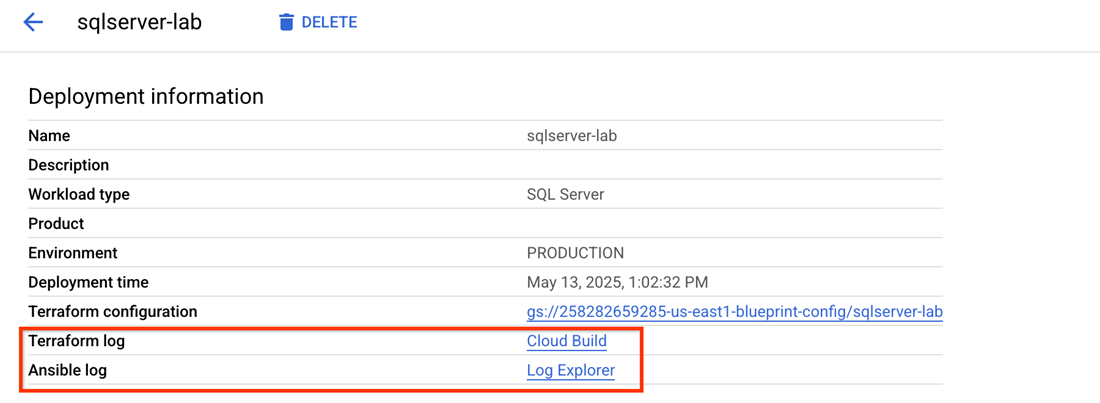
If the deployment fails, check the Terraform logs and Ansible logs for troubleshooting.
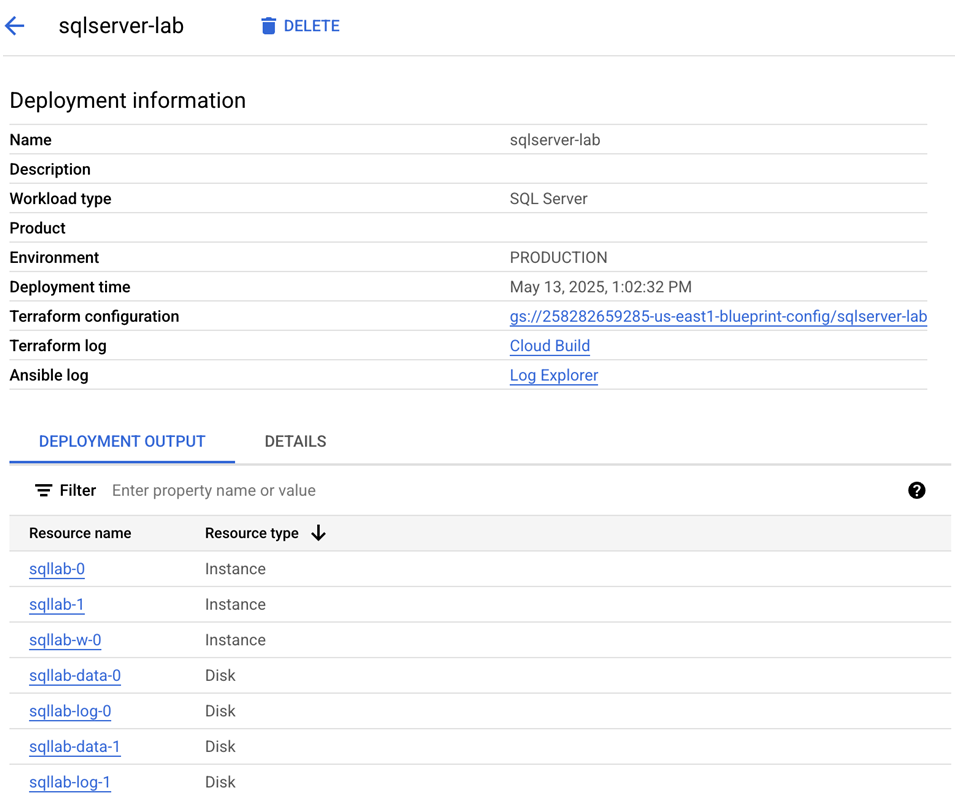
Each cluster should consist of two SQL Server nodes and one witness. Each SQL server node will have two allocated disks: a data disk and a log disk, resulting in a total of four disk resources.
You've successfully deployed SQL Server Always On availability group cluster.
To learn more about Workload Manager, refer to the Workload Manager Documentation.
...helps you make the most of Google Cloud technologies. Our classes include technical skills and best practices to help you get up to speed quickly and continue your learning journey. We offer fundamental to advanced level training, with on-demand, live, and virtual options to suit your busy schedule. Certifications help you validate and prove your skill and expertise in Google Cloud technologies.
Manual Last Updated June 30, 2025
Lab Last Tested June 30, 2025
Copyright 2026 Google LLC. All rights reserved. Google and the Google logo are trademarks of Google LLC. All other company and product names may be trademarks of the respective companies with which they are associated.



此内容目前不可用
一旦可用,我们会通过电子邮件告知您

太好了!
一旦可用,我们会通过电子邮件告知您


一次一个实验
确认结束所有现有实验并开始此实验